Marie Antoinette Makeup: Beauty at Versailles
Discover Marie Antoinette makeup and Rococo court beauty at Versailles: white ceruse skin, rouge circles, silk mouches and the towering pouf hairstyle.
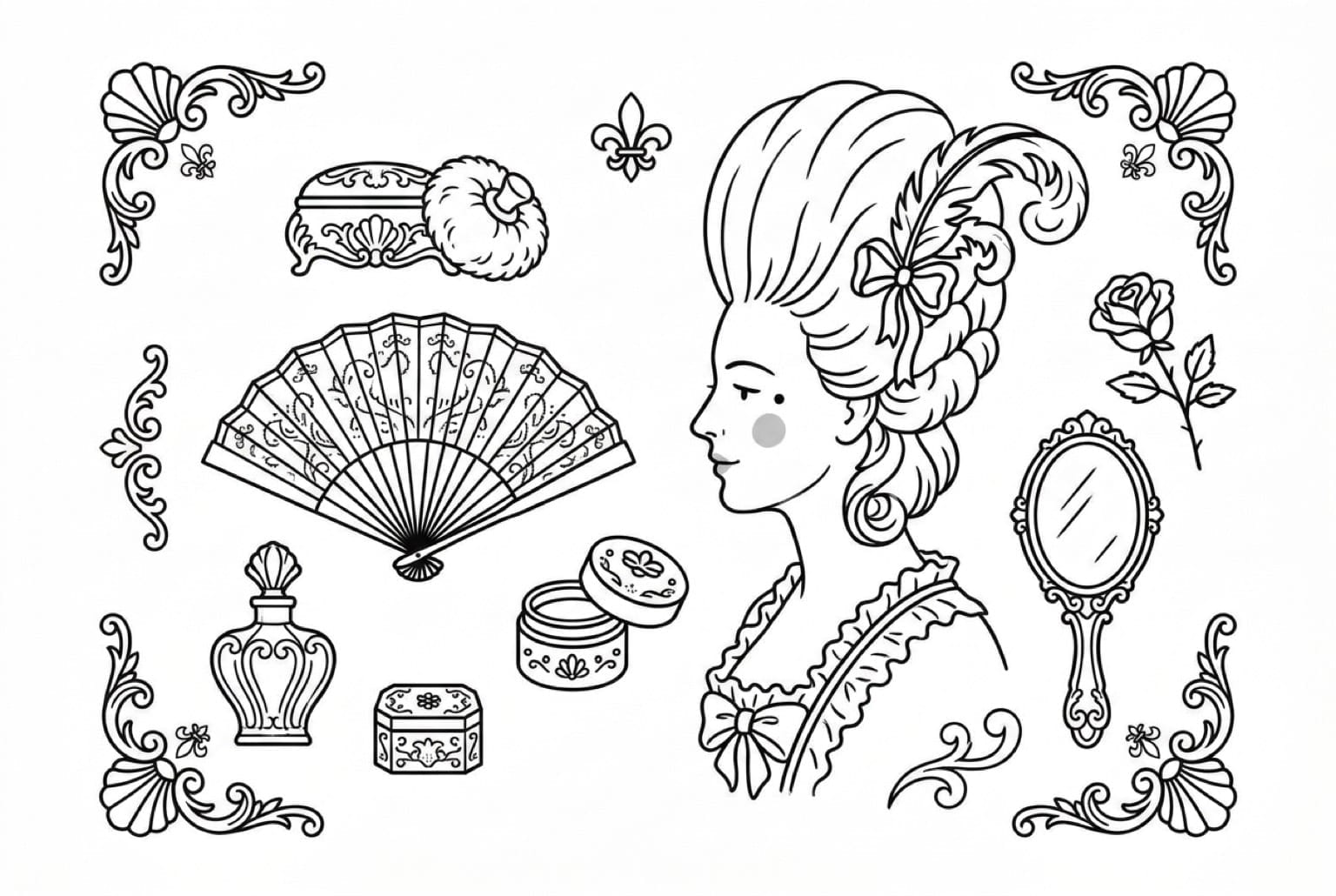
Few faces in beauty history are as instantly recognisable as Marie Antoinette’s: the chalk-white complexion, the two vivid discs of rouge, a scattering of black silk patches and, crowning it all, a tower of powdered hair so tall it seemed to defy gravity. She was not simply following the fashion of the French court; for a generation she was the fashion, the young Austrian archduchess turned Queen of France whose every powder and curl was copied, gossiped about and eventually held against her. To understand her look is to understand a whole philosophy of appearance, one in which artifice was not a flaw but the entire point. At Versailles, a natural face was a peasant’s face. Beauty was a performance of rank, and the more visibly constructed it was, the more powerful the woman wearing it.
This is the world of Rococo beauty at its most extravagant: the France of the 1770s and 1780s, where an aristocrat’s morning toilette could last hours and be attended by a small audience. It is a story of white lead and carmine, of coded beauty spots and a hairdresser treated almost as a court official, and of a culture of ornament so complete that when the Revolution came, one of its first casualties was the painted face itself.
The Porcelain Ideal: Ceruse and the White Face
The foundation of the fashionable eighteenth-century face, quite literally, was whiteness. A pale complexion signalled that you did not labour in the sun, that you belonged to the leisured classes who lived indoors by candlelight. To achieve it, women of the court reached for blanc de céruse — a cosmetic made from white lead, ground and mixed into a paste or wash that was spread over the face, neck and décolletage to create a smooth, luminous, almost inhuman pallor.
The effect was prized precisely because it looked like porcelain rather than skin. Over the top, subtle blue lines were sometimes drawn to suggest delicate veins beneath translucent flesh, heightening the illusion of aristocratic fragility. It was beauty as a kind of living statuary.
The trouble, of course, was that white lead is a poison. Prolonged use of ceruse damaged the skin it was meant to beautify, causing it to grey, coarsen and erupt, which in turn drove women to apply yet more of the cosmetic to cover the harm. Beyond the surface, lead is a cumulative toxin linked to headaches, tremors, infertility and, in the worst cases, an early death. This was not a danger unique to France; the same lethal recipe had painted the faces of the Elizabethan court two centuries earlier, and the parallels with Elizabethan makeup and its own “mask of youth” are striking. What Versailles added was scale and spectacle. If you have read about the toxic cosmetics of the Tudor era, the eighteenth-century court simply carried that gamble into a new age of excess, trading danger for the appearance of divine, untouchable status.
Rouge as Rank: The Theatrical Circles of Red
If the white face was the canvas, rouge was the signature, and nowhere was it applied with such deliberate boldness as at the French court. Where an Englishwoman might use rouge to mimic a soft natural blush, the French aristocrat did the opposite. She applied it in strong, near-circular patches of vivid red high on the cheeks, making no attempt to look natural at all. The point was to be seen to be wearing it.
This was because rouge, at Versailles, was regulated by an unspoken code of rank. The brightest, most saturated, most theatrically applied rouge was the privilege of the highest-born women at court. A duchess wore her red with an intensity that a lesser noblewoman would not presume to match; the deeper and more artificial the colour, the higher the status it proclaimed. Rouge was so bound up with courtly identity that it functioned almost as a uniform — a woman presented at court was expected to be visibly, unmistakably painted.
The pigments themselves ranged from cheaper vegetable-based reds to the coveted carmine, derived from crushed cochineal insects, which gave the richest and most expensive crimson. Applied over the dead-white ceruse, these circles of red produced the doll-like contrast we recognise today: two bright roundels floating on a field of chalk. To modern eyes it can look almost clownish, but that reading misses the logic entirely. This was not an attempt to enhance nature. It was a declaration that the wearer stood so far above nature that she need not imitate it.
Mouches: The Secret Language of Beauty Patches
Scattered across that pale, rouged face you would almost always find mouches — literally “flies” — the small patches of black silk or velvet, cut into shapes and pressed onto the skin. Practical in origin, since a well-placed patch could hide a smallpox scar or a lead-damaged blemish, the mouche quickly became something far more playful: an accessory, a punctuation mark and, according to enduring tradition, a coded language of its own.
The patches were cut into tiny stars, crescents, hearts, diamonds and circles, and their placement was said to carry meaning. A patch near the eye might be read as passionate; one at the corner of the mouth as flirtatious or willing to be kissed; one on the cheek as demure; one by the lip as coquettish. Whether every courtier truly read these signals with dictionary precision is doubtful, but the idea of a secret grammar of patches delighted the age, and fashionable women carried little decorated boxes — boîtes à mouches — filled with a supply of them, ready to be reapplied throughout the day.
There was even a fleeting political dimension: at certain moments patches worn on one side of the face versus the other were joked about as signalling allegiance to a court faction. The mouche, in other words, turned a scrap of black silk into a wearable message. It is one of the most charming details of Rococo beauty and a reminder that this was a face designed to be read, decoded and discussed. For a fuller picture of how these conventions developed across the century, the wider world of Georgian and Rococo makeup is a rich companion to Marie Antoinette’s own story.
The Pouf: Hair as Architecture
No element of the Marie Antoinette look has proved more enduring in the popular imagination than the hair — those improbable, towering constructions of powdered curls, ribbons and ornament that rose a foot or more above the head. The style was known as the pouf, and at its most extreme it was less a hairstyle than a piece of scaffolding.
The pouf was built up over a frame or pad, with the wearer’s own hair supplemented by horsehair and false pieces, then dressed with pomade and dusted heavily with powder — often greyish-white, sometimes tinted. Onto this base almost anything could be arranged: cascades of curls, gauze, flowers, feathers and, in the most celebrated examples, miniature scenes. The famous pouf à la Belle Poule, commemorating a French naval victory, is said to have carried a model ship riding the “waves” of a lady’s hair. Others marked births, sentiments or events, turning the head into a piece of topical commentary.
Maintaining such a structure was an ordeal. A grand pouf might stay in place for days or even weeks, slept upon carefully, protected at night, and — inevitably — prone to attracting vermin, which spawned its own small industry of scratching implements. That women endured all this speaks to how completely hair had become a canvas for status and wit. The pouf was expensive, time-consuming and physically demanding, which was precisely what made it desirable: it was leisure and wealth made visible, balanced atop the skull.
Léonard and Rose Bertin: The Architects of a Queen
Marie Antoinette did not build her image alone. Behind the most famous look of the era stood two remarkable professionals whose influence tells us a great deal about how seriously appearance was taken at Versailles.
The first was Léonard Autié, known simply as Léonard, the celebrated hairdresser who dressed the Queen’s hair and is credited with realising many of her most spectacular poufs. To be the coiffeur of the Queen of France was to hold real cultural power; Léonard’s creations set trends that rippled outward through the aristocracy and beyond, and his partnership with the Queen elevated hairdressing to something close to an art form.
The second, and arguably more consequential, was Rose Bertin, the fashion merchant and dressmaker whom contemporaries nicknamed the “Minister of Fashion.” Bertin held regular sessions with Marie Antoinette, supplying gowns, trimmings and ideas, and through her closeness to the Queen she became one of the most powerful women in the French fashion trade — a commoner whose taste shaped how a queen appeared to the world. That a marchande de modes could rise to such prominence was itself a small revolution, a sign that the machinery of style was becoming a serious industry. Together, Léonard and Bertin functioned as the creative directors of a royal brand, decades before such a phrase existed. As a working makeup artist, I find their story oddly familiar: the trust between a public figure and the people who craft her image is real, and it is a lineage that runs directly to the famous makeup artists who define looks today.
The Scent of the Court: Fragrance and Artifice
Beauty at Versailles was not only a matter of what could be seen. In an age when regular bathing was uncommon and hygiene primitive by modern standards, fragrance was an essential layer of the aristocratic face — worn on the skin, the clothes, the gloves and the hair alike. The court was famously perfumed to the point that it was sometimes called la cour parfumée.
Marie Antoinette herself was devoted to scent, favouring delicate floral and powdery compositions — violet, rose, iris and orange blossom among them — rather than the heavier animalic musks of an earlier taste. Her patronage helped push perfumery towards lighter, fresher blends, and her personal perfumers were as much a part of her entourage as her hairdresser and her dressmaker. Perfume also carried the same logic as everything else in this world: rare ingredients and bespoke blends were markers of wealth, and to smell expensive was to advertise one’s rank as surely as to wear bright rouge.
Fragrance completed the total transformation the Rococo ideal demanded. The finished aristocrat was a constructed object from head to toe — painted, powdered, patched, coiffed and scented — a walking work of art in which almost nothing was left as nature had made it.
Artifice as Status — and the Revolution That Swept It Away
To understand why anyone would submit to lead poisoning, days-old hair and hours at the mirror, we have to take seriously the idea at the centre of it all: at Versailles, visible artifice was the whole point. A face that looked worked-upon announced that its owner had the time, money and rank to be worked upon. Naturalness was not admired; it was the mark of those who could not afford to be anything else. The painted Rococo face was, in its way, a costume of power.
That equation could only hold so long as the aristocracy’s power went unquestioned — and after 1789 it did not. The French Revolution did not merely topple a political order; it discredited the entire aesthetic that had expressed it. The white face and blazing rouge, once symbols of elevated status, curdled into symbols of a corrupt and out-of-touch elite. Marie Antoinette, who had been the living emblem of courtly beauty, became the emblem of its excess, and she went to the guillotine in 1793 stripped of the finery that had once defined her.
In the years that followed, fashion swung hard towards restraint. The heavy paint, the towering poufs and the coded patches gave way to simpler dress, softer complexions and a new cult of the natural, drawing on classical antiquity for inspiration. It was one of the sharpest turns in the whole history of makeup: almost overnight, the ideal shifted from constructed to seemingly effortless. Yet the Rococo face never entirely vanished. Every time a designer sends a model down the runway in white powder and geometric rouge, every time a film or editorial reaches for opulent excess, it is Marie Antoinette’s Versailles being summoned once more — proof that a look this bold refuses to stay buried.
If you love this era of painted extravagance and would like a period-inspired or editorial makeup look created for a shoot or event, do get in touch — I work by appointment across London.