Georgian and Rococo Beauty: Powder, Patches and the Marie Antoinette Era
The 18th century was beauty at its most theatrical — white-lead complexions, rouged cheeks, beauty patches and towering powdered hair at the courts of Europe.
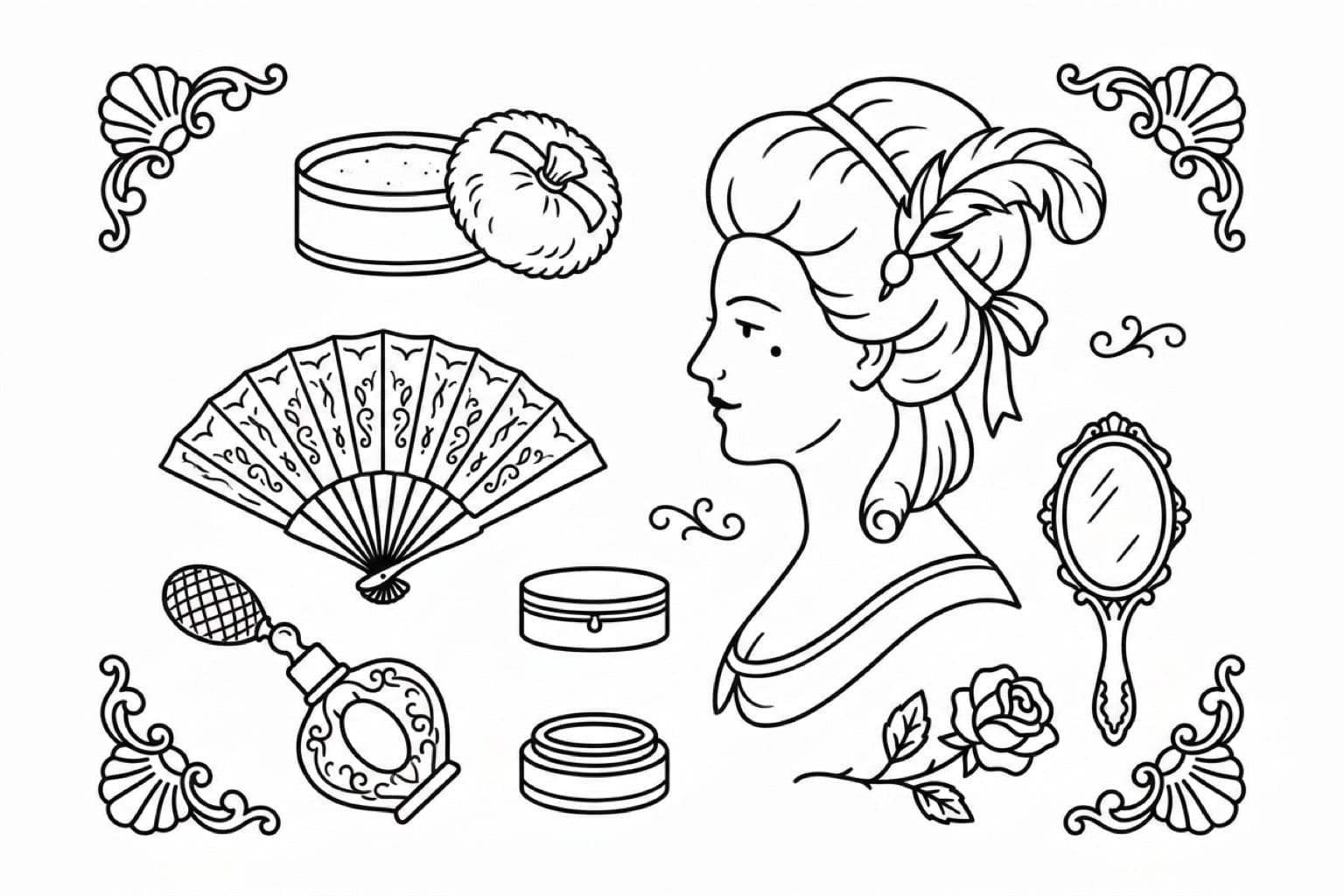
There are eras of beauty that whisper, and there are eras that announce themselves from across a candlelit room. The 18th century belongs firmly to the second kind. Between roughly 1714 and 1830, the courts of Georgian Britain and Rococo France turned the human face into something closer to a painted miniature than a complexion — chalk-white skin, two perfect circles of rouge, a scatter of silk patches, and hair built upward into architecture. It is the most theatrical chapter in the whole long story of cosmetics, and as a working makeup artist I find it endlessly instructive. Nothing teaches you more about restraint than studying a century that had absolutely none of it.
The Most Artificial Face in History
To understand Georgian and Rococo beauty, you have to abandon any modern instinct toward the natural. The 18th-century ideal was not a flattered version of a real face; it was a deliberate, visible construction. Skin was meant to read as porcelain, cheeks as paint, lips as a small red bow. The point was not to look as though you had been blessed with good colouring — it was to look as though you had been finished, like a piece of decorative china.
This was a fashion that travelled in one direction across the Channel. France, and specifically the French court, set the rules; Britain adapted and grumbled and copied them anyway. If you’ve followed this Beauty Journal through the earlier centuries, you’ll recognise the pattern — the pale, painted aristocratic face had been building since the Tudor era, but the Rococo period pushed every element of it to a glorious, slightly absurd extreme.
Venetian Ceruse and the Price of a Perfect Complexion
The foundation of the whole look — literally — was a white face. The most prized cosmetic for achieving it was Venetian ceruse, a paste made from white lead and vinegar that produced a smooth, luminous, opaque finish unmatched by anything else available. Applied over the face, neck and décolletage, it gave that flat, doll-like pallor that defines almost every court portrait of the age.
It was also slowly lethal. White lead is a cumulative poison absorbed through the skin, and the symptoms read like a grim inventory of the very things the cosmetic was meant to hide: it damaged the skin it sat upon, causing it to grey, scar and wither, which prompted heavier and heavier reapplication. Beyond the skin, lead poisoning brought hair loss, rotting teeth, abdominal pain, tremors and, in time, death.
Maria Gunning, Countess of Coventry
The era’s most famous cautionary tale is Maria Gunning, Countess of Coventry, one of two celebrated Irish sisters who took fashionable London by storm in the 1750s. A great beauty and an enthusiastic user of white-lead cosmetics, she is widely held to have died in 1760, in her late twenties, from the effects of the very paint that made her face so admired. Whether one calls it the first famous death-by-cosmetics or simply a vivid illustration of a known danger, her story circulated for generations as a warning that nobody much heeded.
I always think of her when discussing the modern obsession with full-coverage, flawless skin. We have far better tools now, of course, and nothing on the market will harm you the way ceruse did — but the impulse to erase the real surface of the face entirely is not new at all.
Round Rouge, High and Bright
Against that white canvas, the 18th century placed colour with startling boldness. Rouge was not blended or contoured in any sense we’d recognise; it was applied as a vivid, often almost circular patch of red high on the cheekbones, frequently extending toward the eye. At its most extreme — and the French court took it to extremes — rouge could look like two deliberate, near-geometric roundels of pink or scarlet, sitting unapologetically on top of the pale skin rather than melting into it.
There was a logic to the brightness. By candlelight, in gilded rooms hung with mirrors, strong colour read far more naturally than it does in a modern photograph. The intensity also signalled rank: at Versailles, conspicuous rouge was practically a court uniform, a visible marker that you belonged to the painted, privileged world of the aristocracy rather than the bare-faced provinces. Lips, by contrast, were kept small and red — a tight rosebud mouth was the ideal, often made with vermilion or carmine-based salves.
The Language of Beauty Patches
Perhaps my favourite element of the whole period is the beauty patch — the mouche, French for “fly,” because that is rather what a small dark spot on pale skin resembles. Patches were tiny shapes cut from black silk, velvet or taffeta and stuck to the face, and they did double duty: decorative on the one hand, and practical on the other, since they conveniently covered the smallpox scars and skin blemishes that the white lead itself often caused.
They came in a charming variety of shapes — dots, crescents, stars, hearts, even tiny coaches and ships for the truly committed — and were kept in small ornamental patch boxes carried by both women and men.
Did patches really have a secret language?
This is where I have to put on my professional honesty hat. It is widely repeated that the placement of a patch carried a coded message — a patch near the lips for the flirtatious, one by the eye for the passionate, one on the cheek to signal availability, and so on. There is genuine period evidence that contemporaries played with these associations and that satirists certainly wrote about them, so the idea wasn’t pure invention. But I’d treat the neat dictionary-style lists of “this spot means exactly this” with a pinch of salt; much of it was social game-playing and later embroidery rather than a fixed, agreed code. What’s true beyond doubt is that patches were worn to be noticed and to draw the eye to the prettiest part of the face — a piece of styling psychology any makeup artist still uses today.
In one chapter of British history, patches even carried political meaning, with women reportedly wearing them on one cheek or the other to advertise their party loyalties. Whether that was widespread or simply a memorable anecdote, it tells you how much these little scraps of silk were doing socially.
Plumpers, Bad Teeth and the Vanity of the Age
It’s easy to look at the powdered portraits and forget the bodies underneath them. The 18th century had dreadful dental health — sugar had become affordable and fashionable, dentistry was primitive, and the lead and mercury in cosmetics rotted teeth from the inside. Many fashionable faces were, frankly, missing teeth.
The solution was characteristically ingenious and slightly comic: plumpers, small balls of cork or similar light material tucked inside the cheeks to round out a face that had collapsed inward from tooth loss. They restored the plump, youthful curve that the era prized, at the cost of making conversation and eating rather an adventure. It is a wonderfully human detail — a reminder that behind the serene painted surface there was a great deal of practical desperation. The maximalist makeup of the period wasn’t only about display; very often it was about repair, hiding the damage that the lifestyle and the cosmetics themselves had done.
Hair as Architecture
If the face was a painted miniature, the hair was a building. By the 1770s, fashionable hairstyles — the pouf above all — had risen to genuinely extraordinary heights, built up over wire frames, wool and horsehair pads, then dressed, curled, pomaded and powdered into towering confections that could be decorated with ribbons, flowers, jewels, feathers and, in the most famous excesses, miniature scenes and model ships.
The mechanics are worth knowing if you ever recreate the look:
- Pomade — a greasy, often scented pomatum (typically animal fat-based) was worked through the hair first, both to hold the shape and to give the powder something to cling to.
- Hair powder — over the pomade went the powder itself, usually finely ground starch or flour, sometimes tinted faintly grey, blue, violet or pink. This is the origin of the powdered, near-white hair we associate with the whole century.
- Scent and concealment — heavily perfumed pomades helped mask the inevitable smell of a structure that might stay up, unwashed, for days or weeks.
The grey-white powdered hair, incidentally, is one of the most persistent visual shorthand we have for “the 1700s” — and it was worn just as readily by men as by women.
The 1795 Hair-Powder Tax
The towering powdered look met a very British end: taxation. In 1795, Pitt’s government introduced a tax requiring those who wished to use hair powder to buy an annual certificate. With flour increasingly needed for bread during wartime shortages, powdering one’s hair with what was essentially food had started to look both expensive and unpatriotic. The tax — combined with shifting political winds after the French Revolution, which made conspicuous aristocratic display dangerous to flaunt — helped kill the fashion. Powdered hair faded fast, and the natural-coloured, simpler styles of the new century moved in.
Painted Men: Macaroni Fashion
One of the things I most want readers to take from this period is that cosmetics were emphatically not a women-only affair. Fashionable 18th-century men powdered their hair and faces, wore rouge, applied patches and scented themselves lavishly. The painted male face was a sign of breeding and leisure, not a transgression.
The phenomenon reached its peak — and its mockery — in the macaroni. In the 1760s and 1770s, young Englishmen who had returned from the Grand Tour of Europe brought back exaggerated continental fashions: enormous powdered wigs, tight bright clothing, delicate manners, and a full complement of cosmetics. Dubbed “macaronis” after the then-exotic Italian dish, they became the satirists’ favourite target and gave us the still-puzzling line in Yankee Doodle about sticking a feather in his cap and calling it macaroni. They were the dandies of their day, and their faces were every bit as constructed as any duchess’s. It would not be until the Victorian period that visible makeup on a man — or, increasingly, on any “respectable” person — became something to be hidden rather than flaunted.
Marie Antoinette and the Court as Style Engine
No single figure embodies Rococo beauty like Marie Antoinette. As the young Dauphine and then Queen of France, she sat at the centre of a court that functioned as the fashion capital of Europe, and the trends radiating out from Versailles — the towering poufs, the rouged porcelain face, the patch boxes and pomades — were watched, copied and resented across the continent.
She worked closely with the tastemakers who built that image: the milliner Rose Bertin, who dressed her, and the celebrated hairdresser Léonard, who helped engineer the most spectacular of the poufs. Together they made the Queen a kind of walking advertisement for the Rococo ideal — and, in time, a lightning rod for everything the public came to resent about aristocratic extravagance. The very artifice that made her the most fashionable woman in Europe became, in the pamphlets and caricatures, evidence of a court hopelessly detached from a starving country.
After the Revolution: Beauty Strips Itself Bare
The French Revolution did not only topple a monarchy; it toppled a face. Once the Terror made aristocratic display genuinely perilous, the entire visual language of Rococo beauty became a liability. Powdered hair, painted complexions and conspicuous rouge read, suddenly, as the markings of the guillotined class.
What replaced it was the neoclassical look of the very end of the 18th and start of the 19th centuries — and the swing could hardly have been more complete. Inspired by an idealised vision of ancient Greece and Rome, fashionable women adopted simple white muslin gowns, natural hair worn in loose classical styles, and a far more restrained approach to the face. The ideal shifted from visible paint to the appearance of natural, healthy, virtuous beauty — pale still, but pale in a soft, modest, supposedly unpainted way. Rouge thinned to a discreet flush; the patches and poufs vanished almost entirely.
It’s a genuinely fascinating hinge in beauty history: in the space of a single generation, the culture pivoted from the most artificial face it had ever worn to one that prized the illusion of no makeup at all. That tension — between visible artifice and apparent naturalness — never really goes away. It carries straight through into the restrained, scrubbed-clean respectability that would define the Edwardian years, and honestly it’s the same conversation we’re still having on every shoot today.
A Note for the Bridgerton Generation
I can’t write about this period in 2026 without acknowledging why so many clients suddenly want to talk about it. The wave of lavish costume dramas — Bridgerton most of all, alongside Sofia Coppola’s Marie Antoinette before it — has put Rococo beauty back in front of millions, and it’s genuinely changed what people ask me for. Soft powdered complexions, a high circular flush, a single tiny patch, a tumble of pinned curls: these are showing up at weddings and themed parties and, naturally, on set.
The skill in recreating it now is knowing what to keep and what to translate. We keep the porcelain skin (with modern, safe products), the bright high cheek, the rosebud lip and the playful patch. We quietly drop the lead, the cork plumpers and the wire-framed tower. For editorial and period shoots, this is some of the most rewarding work I do — building a face that reads unmistakably as the 18th century to a camera while sitting comfortably and safely on a real, breathing person for ten hours.
Conclusion
The Georgian and Rococo era is, to me, the great cautionary romance of makeup history. It produced some of the most beautiful, imaginative, theatrical faces ever assembled — and it built a fair number of them on poison, decay and a kind of collective denial about what all that paint was actually doing. The same century that gave us the playful genius of the patch box gave us Maria Gunning’s early death and a court so committed to artifice it became a symbol of everything that needed to be swept away.
What I love about studying it is the reminder that beauty is always a negotiation with its moment. When the moment demanded spectacle, faces became miniatures and hair became architecture. When the moment changed — when revolution made extravagance dangerous — the very same culture stripped itself down to muslin and a natural flush almost overnight. Neither extreme was right or wrong; each was simply the truest expression of what its world valued.
And that, perhaps, is the most useful lesson a modern makeup artist can carry. Whether I’m doing a quiet, skin-led bridal look or building a full Rococo fantasy for a period shoot, I’m doing exactly what those 18th-century hands were doing: reading the moment, and painting it onto a face. The tools are safer now, and thank goodness for that — but the impulse to make a face speak the language of its time is as old as cosmetics themselves, and it’s not going anywhere.