Elizabethan Makeup & the Mask of Youth
Discover Elizabethan makeup: the white lead ceruse, vermilion lips and the Mask of Youth that kept Elizabeth I ageless. A London makeup artist's history.
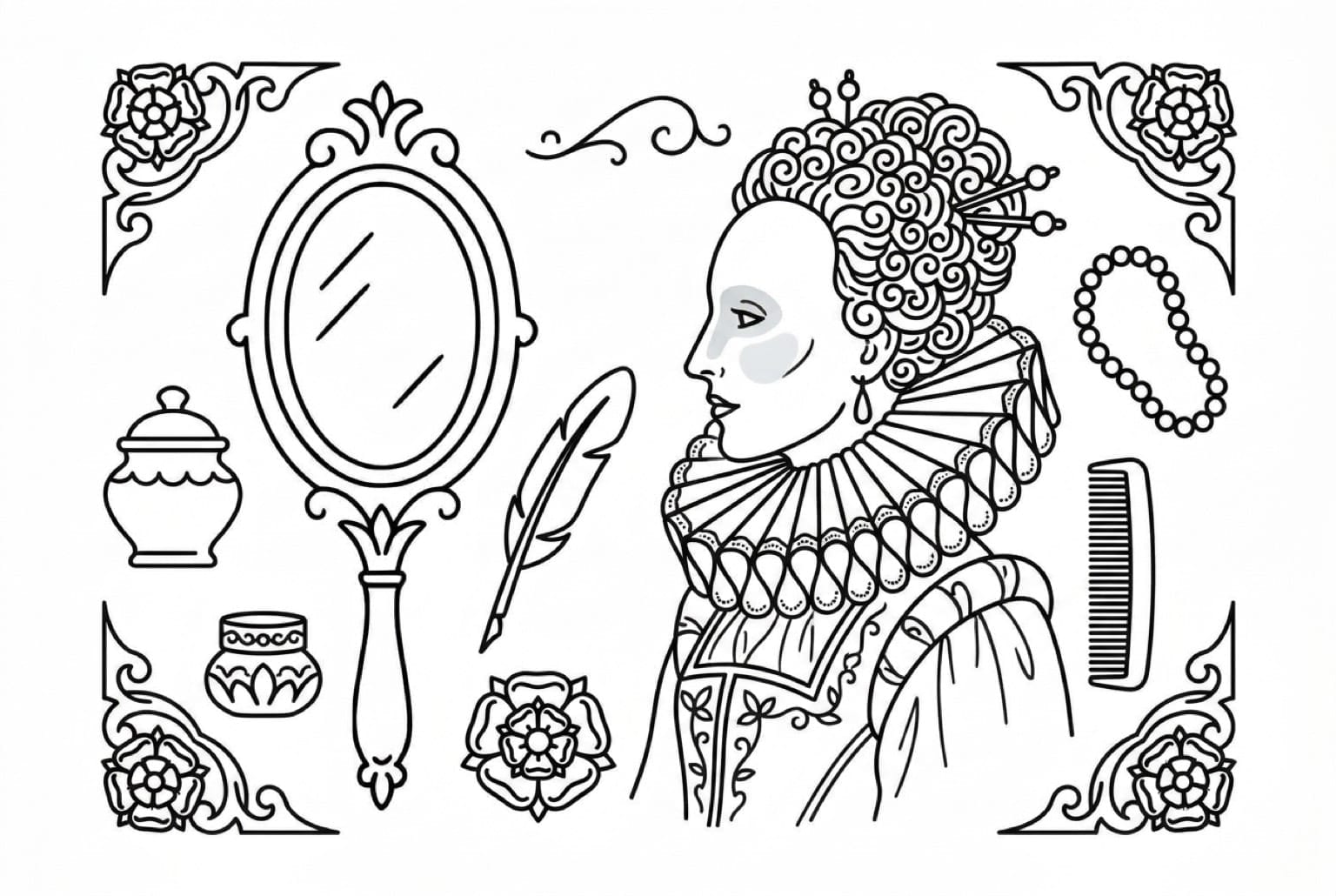
Few faces in English history are as instantly recognisable as that of Elizabeth I: the chalk-white skin, the small crimson mouth, the impossibly high forehead crowned with red-gold hair. It is a face that stares out of the great state portraits like a painted icon, ageless and unblinking. That look was no accident. It was a deliberate construction, assembled from lead, vinegar, crushed insects and egg white, and maintained with the discipline of a woman who understood that in her world, appearance was politics. The Elizabethan makeup of the late sixteenth century is one of the most striking cosmetic styles ever worn in Britain, and it tells us a great deal about beauty, power and the price women were willing to pay for both.
As a working makeup artist in London, I find this period endlessly fascinating precisely because it is so extreme. Everything the modern industry warns against, the Elizabethans embraced wholeheartedly. Understanding how and why they did it makes you appreciate just how far the craft has come, and how constant some of its impulses remain.
The Elizabethan face: what “beauty” actually meant
To an Elizabethan, a beautiful woman was pale, and not merely fair. The ideal complexion was luminously white, almost translucent, the colour of alabaster or fresh snow, set off by high cheeks flushed with red and a small, deeply reddened mouth. The forehead was to be broad and smooth, the eyebrows faint, the eyes bright and clear. Poets of the age described their mistresses in exactly these terms: skin of ivory or lily, lips of coral or ruby, cheeks like damask roses.
This was not a look that celebrated nature. It was a look that announced you had risen above nature, and above the need to labour. A pale face said, unmistakably, that you did not toil in fields under the sun. Whiteness was the colour of leisure, of gentility, of money. In an intensely hierarchical society, your complexion was a form of visible rank. This obsession did not begin with the Tudors, of course; it grew out of long-standing ideals you can trace back through medieval beauty, where a fair, unblemished face carried its own moral and social weight. What the Elizabethans added was scale, theatricality and a queen at the very centre of it all.
Venetian ceruse: beauty by poison
The signature Elizabethan complexion was achieved with Venetian ceruse, the most prized and most dangerous cosmetic of the age. Ceruse was white lead, produced by exposing sheets of lead to vinegar fumes until a white crust of lead carbonate formed, which was then scraped off, ground and mixed into a paint. The “Venetian” grade was considered the finest and whitest, and it was correspondingly expensive, which only added to its allure among the wealthy.
Applied in a smooth layer across the face and the exposed skin of the neck and chest, ceruse produced exactly the flawless, uniform whiteness that fashion demanded. It covered blemishes, evened out tone and gave the skin the matte, sculptural quality you see in the portraits. To the women who wore it, it must have seemed miraculous.
It was, of course, slowly poisoning them. Lead is a cumulative toxin absorbed through the skin. Prolonged use caused the very problems it was meant to hide: it dried and greyed the complexion, corroded the skin, caused hair loss at the temples and hairline, rotted the teeth and, over years, brought on the tremors, headaches, muscle paralysis and worse that we now recognise as lead poisoning. The cruel logic of it is almost unbearable. As the skin deteriorated beneath the paint, women applied thicker and thicker layers to conceal the damage, driving more lead into their bodies. Beauty and slow ruin arrived in the same pot.
Reddened lips and cheeks: vermilion and cochineal
Against all that whiteness, the Elizabethans set vivid points of red. The mouth was painted small and intense, the cheeks touched with a rosy flush, and the contrast between pale skin and crimson colour was the whole drama of the face.
Two main sources gave that red. One was vermilion, a brilliant scarlet pigment made from mercuric sulphide, the same toxic mineral compound used by painters. It gave an extraordinarily saturated colour but carried its own dangers, adding mercury to the lead already at work. The safer, and increasingly fashionable, alternative was cochineal, a rich crimson dye extracted from dried scale insects imported from the New World. Cochineal produced a deep, jewel-like red that could be worked into lip and cheek colours, and it remains in use, entirely respectably, as a natural colourant to this day.
Lip colour was mixed with a binder such as wax or ground alabaster and applied to shape a small, precise mouth. Cheeks were reddened with the same family of pigments, sometimes blended with a little white to soften them into the fashionable rosy blush rather than a hard stripe. The finished effect, pale ground with sharp red accents, is the foundation of a look that echoes down the centuries, resurfacing in the painted faces of Georgian and Rococo fashion and, much later, in the rouged cheeks of the Victorians.
The high forehead and the vanishing brow
One of the strangest features of the Elizabethan face, to modern eyes, is the forehead. Fashion demanded that it be exceptionally high, broad and bare, and women went to considerable lengths to achieve it. They plucked back their hairline, sometimes by a startling margin, to extend the expanse of clear skin above the eyes. The high forehead was read as a sign of refinement and aristocratic breeding, and it also, conveniently, showed off more of that prized pale complexion.
Eyebrows were treated with the same logic of removal. The Elizabethan brow was thin and faint, plucked to a fine line or nearly away altogether. A heavy brow was considered coarse; a delicate, barely-there arch was elegant. Some women reportedly rubbed walnut oil or other preparations into the plucked areas in the hope of discouraging regrowth. The overall effect, a towering pale forehead above pale, almost browless eyes, gave the face that curiously open, exposed quality that makes the portraits of the period so distinctive. It is a reminder that the shape of the eye and brow has been endlessly redrawn across history, each era certain that its own version is the natural one.
Eyes defined with kohl and soot
For all the emphasis on paleness, the eyes were not left untouched. Against a stark white face, even faint definition reads strongly, and Elizabethan women used dark preparations to brighten and outline the eyes. Kohl, that ancient cosmetic used since the days of the pharaohs, was known and used, and soot or burnt cork could be pressed into service to darken the lash line and lend the eyes clarity and depth.
The aim was brightness and expression rather than the heavy smoked eye of later fashions. A clean, clear, well-defined eye completed the face and kept the whiteness from looking flat. Some women also used drops of belladonna, distilled from deadly nightshade, to dilate the pupils and give the eyes a lustrous, wide appearance, another instance of the era’s willingness to court real danger in pursuit of a look. The lineage of eye-darkening runs unbroken from the ancient world’s kohl straight through to the Elizabethan dressing table.
The final sheen: egg-white glazing
Once the face was painted, there was a finishing step that gave it its characteristic polish. Women coated the completed makeup with a wash of egg white, known as glair, to seal the surface and lend it a smooth, glossy sheen. Dried, the glaze set the pigments in place and produced the porcelain-like finish you can see catching the light in the state portraits.
It was, predictably, an uncomfortable and short-lived triumph. The glaze cracked if the wearer smiled or spoke too freely, which encouraged the famously still, mask-like expressions of the age. A painted, glazed face was not built for laughter; it was built to be beheld. In a very real sense, an Elizabethan noblewoman put on a mask each morning and had to remain composed enough not to break it.
The Mask of Youth: cosmetics as royal power
All of these techniques converged, most famously, on one face: that of the Queen herself. In 1562, when she was still in her twenties, Elizabeth I contracted smallpox and nearly died. She survived, but the disease left her skin scarred. For a monarch whose authority rested partly on her image as an untouchable, near-divine figure, this was a genuine problem, and cosmetics became her answer.
Elizabeth used ceruse, in ever-heavier application, to cover the pockmarks and present a face of unbroken, radiant whiteness. As the decades passed and she aged, the paint grew thicker still, until her makeup functioned as a kind of ageless veneer. Courtiers and portraitists colluded in the effect. In her later years the Crown effectively enforced an idealised likeness, the so-called “Mask of Youth”, a standardised, unlined, eternally young face that was reproduced in official portraits regardless of how the real, ageing Queen actually looked.
This was propaganda in cosmetic form. The Mask of Youth declared that the Virgin Queen was constant, undecaying and above the ordinary ravages of time, a fitting symbol for a stable and enduring realm. Her painted face was not vanity so much as statecraft: a carefully managed image projecting permanence and power at a moment when her mortality would have raised dangerous questions about succession. Few examples in history show so clearly how makeup can be a tool of authority rather than mere adornment.
Red hair, class and the cost of fashion
Because the Queen had red-gold hair, red hair became fashionable, and those not naturally blessed with it reached for dyes and wigs to imitate her colouring. It is a small but telling detail: when the most powerful person in the country embodies a particular look, the whole court, and then the country, follows. The same impulse drove the spread of the pale face and the plucked forehead outward from the elite.
That said, this elaborate cosmetic regime was overwhelmingly the preserve of the wealthy. Venetian ceruse, cochineal and imported dyes were costly, and the leisure to sit and be painted was itself a luxury. For the great majority of Englishwomen, working long days, such a face was neither affordable nor practical. Cosmetics in this era were a marker of class as much as of beauty, and the painted white face was, in part, a declaration of the money and idleness required to maintain it. Moralists railed against paint as deceitful and vain, yet fashion pressed on regardless, as it generally does.
It is worth distinguishing this specifically Elizabethan look from the broader sweep of the century. If you want the fuller picture of the Reformation-era court, the sumptuary laws and the earlier Tudor fashions that set the stage, that story sits alongside this one in my piece on Tudor makeup, while the longer arc of how faces have been painted across the ages runs through the complete history of makeup.
What the Elizabethans still teach us
Standing at a modern dressing table, with its gentle serums and lead-free foundations, it is easy to feel superior to the women who painted themselves with poison. I try not to. The Elizabethan impulses are entirely recognisable: the desire for a flawless, even complexion, the drama of a bold lip against soft skin, the wish to look composed, rested and ageless. What has changed is not the impulse but the safety and sophistication of the tools we use to satisfy it. We can now give a client that luminous, porcelain finish with nothing more sinister than good skincare, a well-chosen base and a steady hand.
The other lesson is subtler. Elizabeth understood that a face can carry meaning, that it can project confidence, status and command as much as beauty. That is something I think about constantly in my own work. Whether I am preparing a bride, an actor or a woman getting ready for an occasion that matters to her, the goal is never to bury her under paint, but to help her present the version of herself she most wants the world to see. The Elizabethans took that idea to a perilous extreme, but the idea itself is sound, and it endures.
If the history of beauty intrigues you as much as it does me, I love talking through it with clients who want their own look to feel considered rather than accidental. Do feel free to get in touch whenever you would like to chat.