The Art of Geisha Makeup: Japan's Living Beauty Tradition
Behind the white face and crimson lips of the geisha lies one of the world's most precise, symbolic and enduring makeup traditions — and its meaning runs deep.
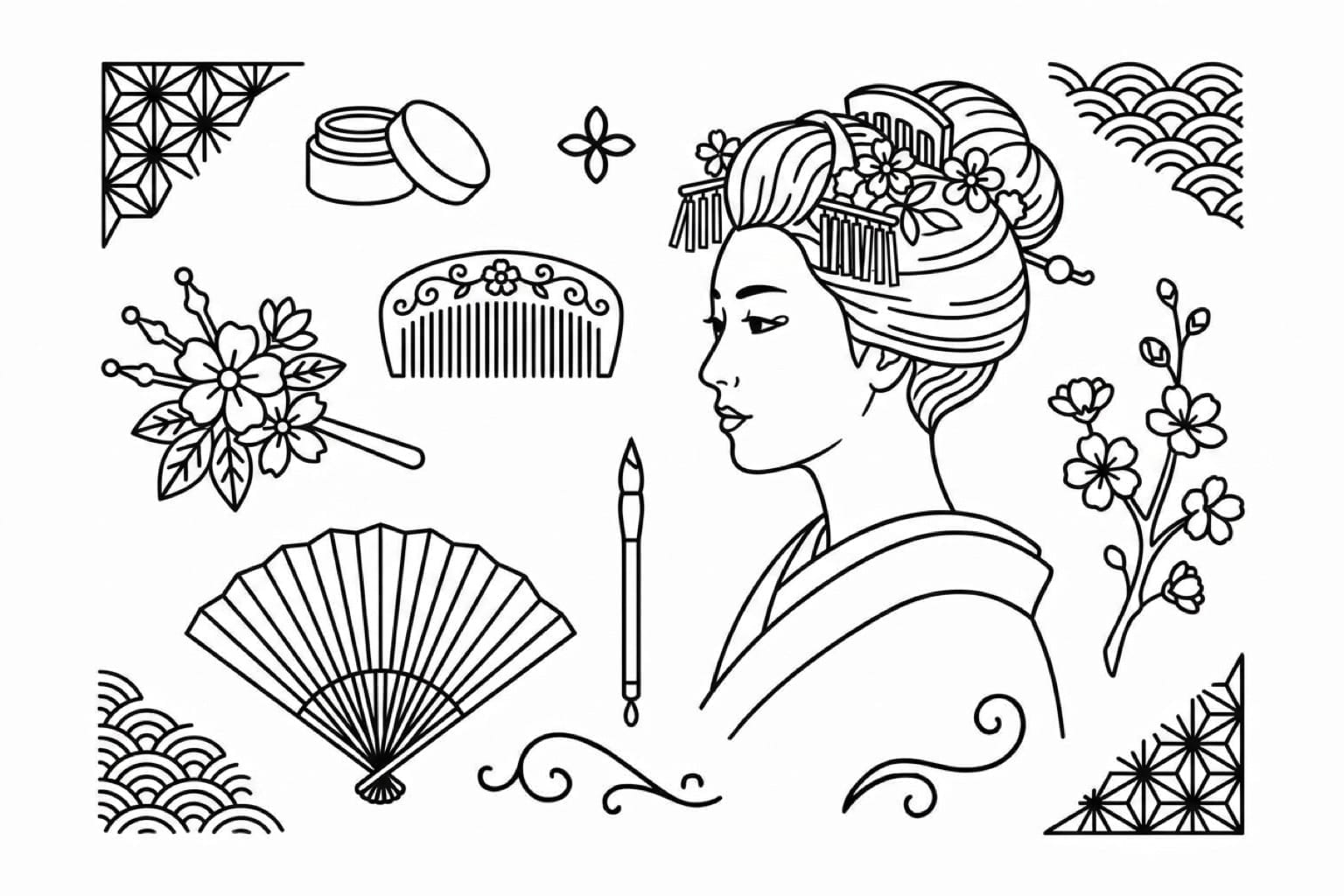
There are few faces in the world as instantly recognisable as the geisha’s: the luminous white base, the small crimson mouth, the dark wing of the brow. Yet for all its fame, this is one of the most misunderstood looks in the whole history of cosmetics. As a makeup artist, I find myself returning to it again and again, not as a costume to be copied but as a discipline to be respected — a system of marks in which every choice carries meaning. To paint a geisha’s face is to read a centuries-old language of pigment, restraint and symbolism. So let me walk you through it carefully, with the care a living tradition deserves.
Geisha, Geiko and Maiko: Getting the Words Right
Before we touch a single brush, the vocabulary matters, because the words themselves correct a great deal of Western myth. The term geisha (芸者) translates roughly as ‘person of the arts’ — gei meaning art, sha meaning person. In Kyoto, the heart of the tradition, these women are more often called geiko (芸妓), ‘woman of the arts’. They are professional artists trained for years in classical Japanese dance, music on the shamisen and other instruments, song, the tea ceremony, calligraphy and the high art of conversation and hospitality.
A maiko (舞妓), literally ‘dancing child’, is an apprentice — typically a teenager in her first years of training, working towards becoming a full geiko. This distinction is not a footnote. Almost everything you can read in a geisha’s makeup tells you, at a glance, whether you are looking at an apprentice or a seasoned artist. The look is, in effect, a uniform and a curriculum vitae worn on the face.
It is also worth saying plainly: the geisha is an entertainer and an artist, not what some Western stories have lazily assumed. The conflation of geisha with prostitution is a misconception, partly born of wartime confusion and partly of cinema. A geiko’s profession is performance, refinement and the keeping of a refined social art alive.
A Tradition Rooted in Court and Custom
The geisha aesthetic did not appear from nowhere. Its white face and reddened mouth reach back to the courtly beauty ideals of the Heian period (794–1185), when aristocratic women powdered their faces pale, painted small red lips, repositioned their brows high on the forehead and, by custom of the time, practised ohaguro — the blackening of the teeth, considered both beautiful and a marker of status and maturity. Pale skin signalled a life lived indoors, away from labour; it was the look of privilege.
If you have read my wider notes on the history of makeup, you’ll recognise a pattern that recurs across cultures: cosmetics as a code for class, age and belonging rather than mere decoration. The same impulse that powdered a Heian noblewoman pale also, in its own way, drove the white-lead ideals of other ancient courts — a thread I trace in my piece on ancient Egyptian makeup, where pigment was likewise inseparable from rank and ritual.
By the time the geisha profession crystallised in the eighteenth century, these older court aesthetics had been distilled into the stylised, deliberate look we recognise today.
Oshiroi: The White Foundation
The white base is called oshiroi (白粉). Historically, in the Heian and later eras, oshiroi was made from rice powder, and at times from white lead and mercury-based compounds. The lead-based versions, as elsewhere in cosmetic history, came at a genuine cost — chronic lead exposure caused real harm over a lifetime of application. Modern oshiroi is made from safe materials, but the historical risk is part of the honest story of this craft and should not be glossed over.
The application is far more involved than simply dusting on powder. First the skin is prepared with a wax-and-oil base traditionally called bintsuke-abura (often shortened to bintsuke), a firm pomade that is warmed and smoothed over the face, neck and the exposed parts of the chest and back. This tacky base gives the white something to cling to and creates that characteristic matte, almost porcelain finish.
The oshiroi itself is mixed with water into a paste and applied with a flat brush in deliberate, even strokes. Getting it smooth, opaque and free of streaks across the face, throat and nape is genuinely difficult — it is a skill that takes apprentices a long time to master, and many maiko are dressed by a professional otokoshi (dresser) in the early years precisely because the technique is so exacting.
The Hairline and the Bare Nape
Two details of the white base are essential, and they are where craft becomes symbolism.
- The unpainted hairline. The oshiroi is stopped short of the natural hairline, leaving a thin border of bare skin around the face. This frames the white like a mask and signals, subtly, that it is a deliberate application rather than a natural complexion — a piece of visual honesty built into the look.
- The bare nape (eri-ashi). At the back of the neck, the dresser leaves either two or three unpainted points of bare skin, forming a W or V shape against the white. In Japanese aesthetics the nape of the neck has long been considered one of the most alluring parts of the body, and the kimono is worn pulled low at the back to expose it. Leaving that bare flash of natural skin within the field of white is one of the most quietly sophisticated ideas in all of cosmetic design — restraint as seduction. Typically a maiko shows the two-pronged design for everyday and the three-pronged version on the most formal occasions.
Beni: The Crimson Mouth
The red is called beni (紅), a precious pigment derived from the safflower. True beni has a remarkable quality — in concentrated form it can shimmer with an iridescent green sheen before it is thinned and warmed into its brilliant red. It was historically expensive, which only added to its status.
The way beni is applied to the lips is one of the clearest markers of rank, and this is where the symbolism becomes almost a calendar of training:
- In her first year, a junior maiko traditionally paints only the lower lip. The upper lip is left white, making the mouth look small, demure and unfinished — a visible sign of a newcomer.
- As she progresses, she paints both lips, though still drawn smaller than the natural lip line to create that signature little rosebud mouth. The Japanese ideal here favours a small, concentrated point of colour rather than a full, lined lip.
This understanding of how a small, saturated mark of colour reads against a pale field is, at heart, applied colour theory — the maximum vividness of red is achieved precisely because it sits alone against unbroken white. It is the same principle I rely on at the chair every day, only refined over centuries into ritual.
Eyes, Brows and Accents
Around the eyes and brows, geisha makeup uses two pigments: black (traditionally a charcoal or sumi-based pigment) and red. The brows are drawn with care — a maiko’s are often shaped softly, sometimes with a touch of red beneath the black to add warmth and depth.
The eyes are accented with black lined along the lash line and, distinctively, a wash of red drawn at the outer corners and along the crease, lifting the eye and giving it a youthful, slightly flushed delicacy. This use of red around the eyes is one of the things people most often get wrong when they imitate the look without understanding it; it is soft and deliberate, not a hard line. The contrast of black, red and white is the entire colour story of the face, and it is held in exquisite balance.
For anyone curious about the underlying craft — the layering, the placement, the way one tone is set against another — the principles overlap a great deal with the broader makeup techniques I write about elsewhere. The tools differ, but the discipline of building a face in considered stages is universal.
How a Maiko’s Face Differs From a Geiko’s
Here is one of the most important and most overlooked truths: the full white face is largely the look of the apprentice, not the master.
A young maiko wears the most elaborate makeup — the fullest white, the most decorative hair ornaments, the most stylised accents — precisely because she is in training and her appearance is the most performative. As she matures into a senior geiko, the makeup is deliberately pared back. In her daily working life a seasoned geiko often wears far less white, sometimes only a refined, near-natural face with carefully done eyes and lips, reserving the full oshiroi for the most formal performances and ceremonial occasions.
The logic is beautiful: the white face signals youth and the early, showier stage of the art. Maturity is signalled by removing it. The most accomplished artist needs the least adornment — a philosophy I find deeply true of makeup in general.
Regional Differences: Kyoto and Tokyo
The tradition is not monolithic. There are meaningful regional differences between the districts where it survives.
- Kyoto (Gion and the other hanamachi) is the most conservative custodian of the older customs, and it is here that the maiko stage of apprenticeship, with its elaborate makeup and trailing kimono, is most fully preserved. The terminology geiko and maiko belongs to Kyoto.
- Tokyo has its own geisha districts (the women there are more often called geisha than geiko, and apprentices hangyoku rather than maiko). The Tokyo style is often described as slightly more understated and modern in its sensibility, reflecting the city’s character.
These are living regional dialects of the same art, each with its own pride and lineage.
The Skill, the Time and the Discipline
It is easy to look at a finished geisha and see only the image. What I see is the labour. The full transformation — base, oshiroi, nape, lips, eyes, brows, then the dressing of the hair and kimono — can take a couple of hours, and much of it for a young maiko is done by a trained dresser because the technique is so demanding. The hairstyles themselves, worn for days, require sleeping on a special raised support to preserve them. The whole edifice rests on years of training in the arts the makeup is in service of.
That is the point I most want to land. The makeup is not the performance; it is the threshold to it. A maiko’s painted face is the visible promise of a dancer, a musician, a keeper of an intricate social art. The face is disciplined because the art behind it is.
Respecting a Living Tradition
The hanamachi of Kyoto are not a museum exhibit — this is a living profession, still practised today, with young women entering apprenticeships and senior geiko performing as they have for generations. That living quality is exactly why care is owed.
There is a real and gentle distinction to be drawn between appreciation and appropriation. To study this tradition, to learn its symbolism, to admire its precision and to credit its origins is appreciation. To don the white face as a Halloween costume, to flatten its meanings into an exotic prop, or to treat a working artist as a photo opportunity, is something else. As makeup artists and as enthusiasts, we can honour the geisha look best not by replicating it casually but by understanding why every mark is where it is — and by leaving the practice itself to those who have given their lives to it. If you ever have the privilege of working with elements inspired by it, doing so with knowledge and credit is everything. It’s the same spirit of informed, respectful craft I bring to my own bridal and editorial work.
Conclusion
The geisha’s face endures because it is so much more than a look. It is a coded text — apprentice or master, everyday or ceremonial, Kyoto or Tokyo, all legible in the reach of the white base, the count of the points at the nape, and whether one lip is painted or two. Every element earns its place, and nothing is arbitrary. That, to me, is the highest definition of makeup as art: not decoration for its own sake, but meaning made visible.
I keep returning to this tradition because it teaches the lesson I most believe in. The crimson reads as crimson because it sits alone against white. The mature artist wears the least. The bare nape is more alluring than any amount of paint. These are not just rules of an exotic craft — they are the deep grammar of beauty itself, refined over centuries into something quietly perfect.
So when you next see that luminous white face, look closer and read it. Behind the image is a young woman learning a difficult art, a dresser’s exacting hand, a pigment drawn from a flower, and a thousand years of aesthetic thought. It deserves not our imitation but our admiration — and the kind of attention that treats living beauty as exactly that: living, and beautiful, and not ours to caricature.