Ancient Egyptian Makeup: Kohl, Cleopatra and the Birth of Cosmetics
Ancient Egypt invented cosmetics as we know them — kohl-lined eyes, malachite shadow and red-ochre lips that carried meaning far beyond beauty.
Whenever I draw a clean line of liner along a client’s lash line, I’m following a gesture that’s more than six thousand years old. The ancient Egyptians didn’t simply decorate their faces — they invented the very idea of cosmetics as a craft, complete with formulated pigments, dedicated applicators, storage pots and a whole grammar of meaning attached to each colour. Kohl-rimmed eyes, green malachite shadow and red-ochre lips weren’t frivolous; they were medicine, magic, status and devotion in equal measure. To understand where modern beauty begins, you have to start on the banks of the Nile, where the first makeup artists ground minerals into pigment and lined their eyes against the desert sun, the gods and the gaze of the dead.
The Dawn of Cosmetics on the Nile
Egypt is where the long story of makeup history effectively opens. Archaeologists have found cosmetic residues, grinding palettes and pigment-stained tools dating back to the Predynastic period, roughly 6,000 years ago and arguably earlier — well before the pyramids rose at Giza. By the time the great dynasties were established, makeup was woven into daily life for rich and poor alike, a fixture of the Egyptian household rather than a luxury reserved for the elite.
What strikes me as a working artist is how recognisably professional their approach already was. They quarried and traded specific minerals, ground them to a fine powder on stone palettes, bound them with fat or gum, and stored the finished product in carved pots and reed tubes. They had applicators shaped for the purpose, formulas refined over generations, and conventions about who wore what. This wasn’t accidental face-painting — it was an industry with supply chains, specialists and an aesthetic code, and it set the template that beauty cultures have followed ever since.
Kohl: The Original Eyeliner
If Egypt gave us one enduring gift, it’s kohl — the dark, dramatic eye paint that defines our mental image of the era. The classic black kohl was made primarily from galena, a naturally occurring lead sulphide ore, ground into a fine powder. Alongside it, Egyptians used soot and other dark minerals to achieve depth and richness. The result was a smooth, intense pigment that could be packed along the lash line and extended outward in those signature elongated lines.
Kohl wasn’t the only eye colour. The Egyptians also prized a vivid green made from malachite, a copper carbonate mineral, which they applied across the lids — a striking green-and-black combination that I’d happily put on a modern editorial face today. Both pigments were ground on cosmetic palettes, often beautifully carved from slate or stone, then bound and stored ready for use.
How it was made and applied
The craft behind the colour was meticulous:
- Galena (lead sulphide) was ground to produce the deep, glossy black we associate with Egyptian eyes.
- Malachite supplied the famous green eyeshadow worn across the upper and sometimes lower lids.
- Soot and charcoal added blackness and could stretch a precious mineral supply.
- A binder such as animal fat, oil or gum turned loose powder into a workable paste.
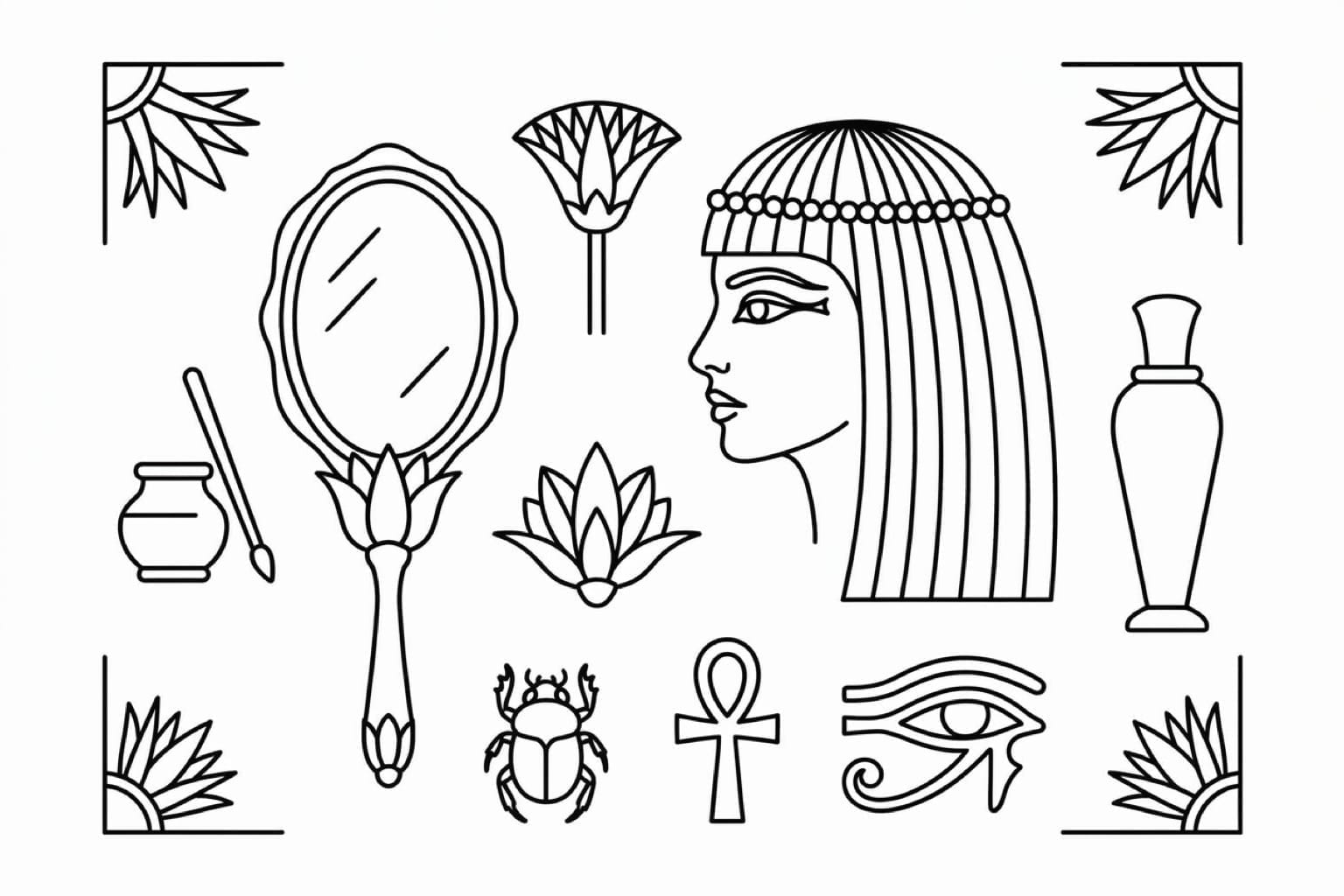
To apply it, Egyptians used a slender kohl stick — a rounded rod of wood, bone, ivory or bronze. The tip was dipped into the powder or paste held in a kohl pot, then drawn along the rim of the eye and out toward the temple. It’s essentially the same motion I make with a pencil or a fine brush, which is why this chapter sits so firmly within the broader evolution of eye makeup. The tools have changed materials; the gesture has not.
A Look Worn by Everyone
One detail that surprises people is that Egyptian eye makeup wasn’t gendered the way later European cosmetics often were. Both men and women wore kohl, and so did children. Pharaohs, priests, labourers, mothers and merchants all lined their eyes. Tomb paintings show kings and queens alike with the same elongated, almond-shaped eyes, and ordinary burials contain the same little pots and sticks found in royal tombs, just in humbler materials.
This universality tells you that makeup in Egypt was functional and meaningful first, decorative second. It belonged to everyone because its purposes — practical and spiritual — applied to everyone. That’s a very different starting point from the way modern Western culture has often coded cosmetics as exclusively feminine, and it’s worth remembering when we talk about who makeup is “for”. In Egypt, the answer was simply: people.
Beauty That Did a Job: The Practical Purposes
Egyptian eye makeup is one of history’s best examples of beauty doing real work. Living under a relentless desert sun, beside a river that bred biting insects and waterborne disease, the Egyptians had every reason to want protection around the eyes — and their cosmetics provided it.
- Reducing sun glare. A band of dark pigment beneath the eye absorbs light and cuts the harsh reflection off sand and water, much as athletes today smear black under their eyes. Egyptians lining their lower lids were doing something genuinely useful in a punishing climate.
- Shielding against dust and insects. The greasy, mineral-rich paste formed a physical barrier that could help keep grit and flies away from the delicate eye area.
- Warding off infection. This is the claim that once sounded like folklore but has gained real scientific support, as I’ll come to below.
On top of these tangible benefits sat a layer of belief: makeup was thought to guard against the “evil eye” — the malevolent gaze that could bring misfortune. The lined eye both protected the wearer’s vision and deflected harm, blurring any line we might draw between cosmetic, medicine and amulet. For the Egyptians there was no such line at all.
Colour as Magic: The Sacred Meaning of the Lined Eye
To Egyptian eyes, the painted face was thick with religious meaning. The elongated, almond shape so often recreated in art echoed the eyes of the gods, and the act of lining them connected the wearer to divine protection.
The most powerful symbol was the wedjat, or Eye of Horus — the restored eye of the falcon god Horus, who lost it in his mythic battle with Set and had it healed. The wedjat became one of Egypt’s great protective emblems, associated with healing, wholeness and safekeeping, and the cosmetic line that mimicked its shape carried some of that protective charge. Green malachite, in particular, was linked to fertility, regeneration and the life-giving power of the gods.
Kohl-rimmed eyes were also bound up with the sun gods Horus and Ra. To line the eyes was, in a sense, to align oneself with solar power and divine sight. So when an Egyptian sat down to apply their makeup each morning, they weren’t only making themselves attractive — they were arming themselves spiritually for the day, invoking gods and deflecting evil with every stroke. As a makeup artist, I find that idea genuinely moving: the notion that pigment could be prayer.
Red Ochre, Henna and the Rest of the Face
Eyes dominate the story, but the Egyptians coloured far more than their lids. For lips and cheeks they reached for red ochre, an iron-oxide pigment ranging from warm orange-red to deep brick. Mixed with fat or resin, ochre gave a stain that tinted the lips and warmed the complexion — the distant ancestor of every blusher and lipstick in my kit, and an early chapter in the long story of lipstick. Some accounts describe additional red pigments and resins used to vary the shade, but ochre was the workhorse, prized because it was earthy, abundant and richly coloured.
Then there was henna, the plant-derived dye that stained skin, nails and hair a warm reddish-brown. Egyptians used henna to colour their fingernails and to tint hair, and it appears in funerary contexts as well — traces have been associated with mummified remains. It was cosmetic and, like so much else, carried ritual weight.
The fuller picture of the Egyptian face included:
- Red ochre for lips and cheeks, the earliest form of lip and cheek colour.
- Henna for nails and hair, and possibly for staining the palms and soles.
- Scented oils and fats to protect skin from the drying sun and to perfume the body.
- Green and black eye paint as the centrepiece, framing the gaze.
Skincare mattered too. In a climate that cracked and aged the skin, richly perfumed oils and unguents were applied to keep the body supple — beauty and bodily care braided together, just as they are in any good modern regimen.
Class, Death and the Eternal Cosmetic Kit
Makeup in Egypt was democratic in use but still spoke of status. The wealthy owned finely carved palettes, polished bronze mirrors, alabaster jars and elaborate applicators, while poorer households made do with simpler pots and wooden sticks. Imported minerals and exotic ingredients signalled means, much as a particular bottle on a dressing table might today. The materials told you who someone was.
Nowhere is the Egyptian devotion to cosmetics clearer than in their tombs. Belief in the afterlife was central to their world, and the dead were equipped for eternity with everything they’d need — including their makeup. Excavated burials regularly contain:
- Cosmetic palettes for grinding pigment, some shaped as animals or symbols.
- Kohl pots and tubes, occasionally still holding traces of the original paint.
- Kohl sticks and applicators in wood, bone, ivory and bronze.
- Mirrors, jars of unguent and remnants of pigment packed for the journey.
These weren’t tokens. They were working kits, placed so the deceased could continue grooming and protecting themselves in the next life. The famous painted faces on coffins and tomb walls — those serene, kohl-lined eyes gazing out across millennia — were meant to ensure the dead could see, be recognised and be protected forever. When we marvel at the makeup on a sarcophagus, we’re looking at cosmetics deployed as a passport to immortality.
Cleopatra: Myth, Reality and the Most Famous Face in History
No account of Egyptian beauty escapes Cleopatra VII, the last active ruler of the Ptolemaic Kingdom and the face most people picture when they hear “Egyptian makeup”. The popular image — heavy black liner sweeping to dramatic points, jewel-bright lids, regal poise — owes as much to cinema as to history. The reality is more interesting and more grounded.
Cleopatra was a Macedonian-Greek ruler of Egypt, and the cosmetic traditions she drew on were the genuine Egyptian ones described here: kohl-lined eyes, malachite green, ochre lips. Ancient writers and later legend credited her with an exacting beauty regimen, and a few enduring stories cling to her name — bathing in milk to soften the skin, using plant and mineral preparations for her complexion. Some such practices are plausible against the backdrop of Egyptian skincare; others are embellishment accreted over centuries. What we can say with confidence is that she was a skilled political operator who understood image and presentation as instruments of power, and that her makeup, whatever its precise recipe, was part of a carefully curated royal persona.
The myths matter because they show how Egyptian beauty became a symbol far larger than any single ingredient. Cleopatra’s painted eyes have stood in for seduction, intelligence and sovereignty for two thousand years. When a client asks me for a “Cleopatra eye”, they’re not requesting galena and malachite — they’re asking for the idea of Egypt: control, drama and a gaze that commands the room.
The Dangerous and the Genuinely Beneficial
Modern eyes wince at the thought of lead-based makeup, and rightly so. Galena is a lead compound, and chronic lead exposure is a real toxic hazard. It would be wrong to romanticise the Egyptian palette without acknowledging that some of its core ingredients carried risk, particularly with the heavy, daily use that was the norm.
And yet the picture is genuinely fascinating, because research into ancient Egyptian eye cosmetics has found that they weren’t simply poisonous folly. Scientific analysis of preserved kohl has identified lead-based compounds — including ones the Egyptians appear to have synthesised deliberately, which is remarkable in itself — that, in tiny quantities, can stimulate the body’s immune response and help fend off eye infection. In a hot, dust-laden environment where eye disease was rampant, a cosmetic that offered even modest antibacterial protection around the eye would have been quietly valuable. Their belief that kohl guarded the eyes against illness, it turns out, had a kernel of truth.
This is the paradox of Egyptian makeup: ingredients we’d never countenance today, yet a sophistication of formulation and a thread of real efficacy that modern science has had to take seriously. It’s a humbling reminder that the line between cosmetic and medicine, danger and benefit, has always been blurry — and that early beauty cultures were often shrewder than we assume.
An Unbroken Line to Modern Makeup
Stand in front of any beauty counter and you’re surrounded by Egypt’s descendants. The smoky eye, the winged liner, the enduring cat eye — all trace straight back to that elongated kohl line drawn beside the Nile. When a flick of liner lifts the outer corner of an eye on a wedding morning, I’m using a shape the Egyptians perfected, for much the same reason: to enlarge, define and dramatise the gaze.
Their influence radiated outward through the ancient world. The cosmetic ideas refined in Egypt fed into and were transformed by the cultures that followed, a thread you can pick up in the makeup of ancient Greece and Rome, where new pigments and ideals layered over older ones. And the Egyptian instinct for pairing colours with intent — green against black, ochre warming the face — is an early, intuitive form of the colour theory that still guides how I build a face: which tones flatter, which contrast, which carry meaning.
The bones of the discipline were all there at the start: pigment, binder, applicator, storage, technique and symbolism. We’ve swapped galena for safe synthetic blacks and stone palettes for plastic ones, but the underlying logic of eye makeup hasn’t moved in six millennia. If you ever want to experience that directly, recreating a true Egyptian or Cleopatra eye for a themed shoot or event is one of the most rewarding looks I offer through my makeup services — it’s history you can wear.
Conclusion
Ancient Egypt didn’t just decorate the face; it founded an art form. In those kohl-rimmed eyes we find the first formulated cosmetics, the first dedicated tools, the first storage and trade in beauty products, and the first sustained belief that what we put on our faces can protect, transform and connect us to something greater than ourselves. Makeup there was medicine, armour, prayer and status all at once — worn by everyone, packed for the afterlife, and bound up with the gods.
That richness is exactly why the era still grips us. Cleopatra’s gaze endures not because of any single recipe but because Egypt fused beauty with meaning so completely that the look became a symbol of power itself. The lead in the kohl warns us; the antibacterial findings humble us; the artistry inspires us. It’s a story with shadows as well as glamour, and it deserves to be told honestly.
Every time I line an eye, I feel that long inheritance at my fingertips. The materials in my kit are modern and safe, but the gesture — that confident sweep along the lash line, lifting toward the temple — is a direct quotation from the banks of the Nile. Egypt taught us that a painted eye can be beautiful and purposeful at once, and more than six thousand years later, we’re still drawing the line they gave us.