Medieval Beauty: Pale Skin, Plucked Brows and the Church's War on Vanity
In the Middle Ages, beauty meant a luminous pale complexion and a high plucked hairline — pursued quietly against a Church that branded cosmetics sinful.
When we picture the medieval lady, we tend to imagine her unadorned — scrubbed, devout, untouched by anything as worldly as cosmetics. The truth is more interesting and far more human. Across the long centuries between roughly 500 and 1500, women pursued a precise and demanding ideal of beauty: skin like alabaster, a forehead high and smooth as an egg, cheeks touched with the faintest warmth. They did this quietly, often discreetly, because the Church watched closely and disapproved loudly. As a makeup artist, I find this era endlessly compelling. It is the story of beauty pushed underground, of women reading what they could and improvising the rest, and of restraint that would, in time, snap dramatically back the other way.
A thousand years is not one moment
The first thing to understand about the medieval period is its sheer length. We are talking about something like a thousand years, from the slow collapse of Roman authority in Western Europe through to the dawn of the Renaissance. To speak of “medieval makeup” as a single style is a little like describing a millennium of British weather in one sentence.
The early medieval centuries — sometimes still unfairly called the Dark Ages — were practical, hard and largely uninterested in elaborate cosmetics for most people. As trade networks recovered and courtly culture flourished from the eleventh and twelfth centuries onward, beauty ideals sharpened into the recognisable look we associate with the high and late Middle Ages. If you have read my notes on the broad sweep of makeup history, you will recognise this rhythm: beauty contracts and expands with prosperity, contact between cultures, and the prevailing mood about the body. The medieval centuries were a long contraction, with bursts of refinement at the top of society.
Geography mattered too. A noblewoman in twelfth-century France or a merchant’s wife in Italy lived in a very different cosmetic world from a peasant in rural England, who had neither the time, the ingredients, nor the cultural permission for such pursuits.
The Church’s long shadow
No discussion of medieval beauty can avoid the Church, because the Church had a great deal to say about it — almost none of it kind.
The theological objection was rooted in a particular idea: that to paint the face was to improve upon, and therefore to criticise, God’s creation. If the Almighty had made your complexion, who were you to repaint it? Worse, cosmetics were framed as a form of deceit. A painted woman was, in the language of moralising sermons and treatises, a liar who presented a false face to the world and lured men into sin. The word that recurs again and again in these texts is “vanity.”
Clergy and moralists returned to this theme relentlessly. Women who “painted” were condemned from pulpits and in conduct literature as proud, dishonest and dangerous. There was an inescapable misogyny to it — Eve’s daughters, forever suspected of luring men astray — and cosmetics became a convenient shorthand for female sinfulness.
Restraint as virtue, and the loophole within it
This pressure shaped the aesthetic itself. The medieval ideal was not the bold, obviously painted face. It was a look that could plausibly be claimed as natural: a fair complexion, clear and luminous, with only the gentlest hint of colour. In a sense, the moral climate produced the “no-makeup makeup” of its day — artifice that worked hard to look like artless good fortune.
There was a quiet loophole, too. Caring for the skin — washing, smoothing, treating blemishes, preserving a youthful surface — sat in a more defensible category than overt painting. A woman might justify her rosewater and her herbal washes as cleanliness and health rather than vanity. That distinction between enhancing the canvas and painting the canvas is one we still negotiate today, and it gave medieval women a little room to manoeuvre.
Pale as a measure of rank
The single most prized feature of the medieval face was a pale, luminous complexion. This was not a passing fashion but a deep social signal that endured for centuries.
Pale skin announced that you did not labour out of doors. A weathered, sun-browned face marked the peasant who worked the fields; smooth, untanned whiteness marked the lady who did not. Fairness was therefore shorthand for nobility, leisure and gentility. It was a class boundary written on the body, and women at the upper end of society guarded it carefully — wide hats, veils, shaded walks and a wardrobe of skin treatments to keep the complexion clear and bright.
This obsession with whiteness is one of the great through-lines of European beauty. You can trace it forward from here into the white-lead complexions of the Tudor court and onward into the powdered faces of the Georgian and Rococo era. The medieval period did not invent the cult of pallor — it inherited some of it from the classical world — but it embedded fairness firmly as the marker of the well-born woman, and that idea proved remarkably durable.
The high forehead and the plucked brow
If pale skin was the foundation, the silhouette of the face was its architecture — and here the medieval ideal becomes genuinely startling to modern eyes.
The fashionable forehead was high, broad and domed. A tall, smooth expanse of brow was considered the height of elegance, particularly in the later medieval centuries. To achieve it, women plucked the hairline back, removing hair from the front of the scalp to raise the forehead dramatically and create that egg-smooth, rounded sweep you see in so many fifteenth-century portraits, often paired with elaborate veils and headdresses that framed and exaggerated the effect.
The eyebrows received the same uncompromising treatment. The ideal brow was thin to the point of near-invisibility, so women plucked them down to the faintest line or removed them almost entirely. Visible eyelashes, too, could be plucked away, leaving the eye area strikingly bare. To us, accustomed to brows as a defining feature of the face — the era of brow gels and microblading — this seems almost unimaginable. But in context it makes its own sense: a clean, open, luminous face, uninterrupted by strong dark features, reading as refined and otherworldly.
What the look was really saying
It is worth pausing on what this silhouette communicated. The high, hairless forehead and faint brows produced a face that looked elevated, spiritual and removed from earthy physicality. In a culture that prized purity and viewed the body with suspicion, a face stripped of its more animal features could read as chaste and elevated. Beauty and piety were uneasy neighbours, and the fashionable face tried, in its way, to belong to both.
Inside the cosmetic kit
So what did medieval women actually use? The ingredients tell a story of resourcefulness, herbal knowledge and, occasionally, real danger.
Whitening the skin
To brighten and pale the complexion, women reached for what their kitchens and apothecaries could provide:
- Wheat flour, dusted on to lighten and matte the skin — a gentle, accessible option for many women.
- Egg white, used as a glaze to smooth the surface of the skin and lend it a tightened, polished sheen.
- White lead, the most effective whitener and the most perilous. Ground and applied as a paste, it gave an opaque, flawless pallor that nothing else could match — at a terrible cost. Lead is a cumulative poison, and prolonged use damaged the skin it was meant to perfect, eventually scarring and greying the complexion and harming health more broadly.
The tragedy of white lead is one of the recurring cautionary tales of cosmetic history. Women knew it whitened beautifully; the slow harm was less obvious, and the social reward for fairness was immediate. This same compromise would echo through the centuries, reaching its notorious peak with the Venetian ceruse of the Tudor age. It is a sobering reminder, when I open a modern, rigorously tested kit, of how hard-won safe cosmetics really are.
A whisper of colour
Against all that pallor, a little warmth was permitted — but only a little, and only if it looked plausibly natural. A subtle flush on the cheeks could be coaxed from plant sources: red and pink dyes drawn from herbs and roots, applied with restraint to mimic the bloom of health rather than the obvious stain of rouge.
Lips were treated with the same caution. A faintly reddened lip was acceptable, achieved with tinted salves or herbal dyes, but bold colour was firmly downplayed. The whole point was deniability — a mouth and cheek that looked kissed by good health, not by pigment. Compared with the frank, openly applied colour of ancient Greece and Rome, the medieval approach was an exercise in near-invisible enhancement.
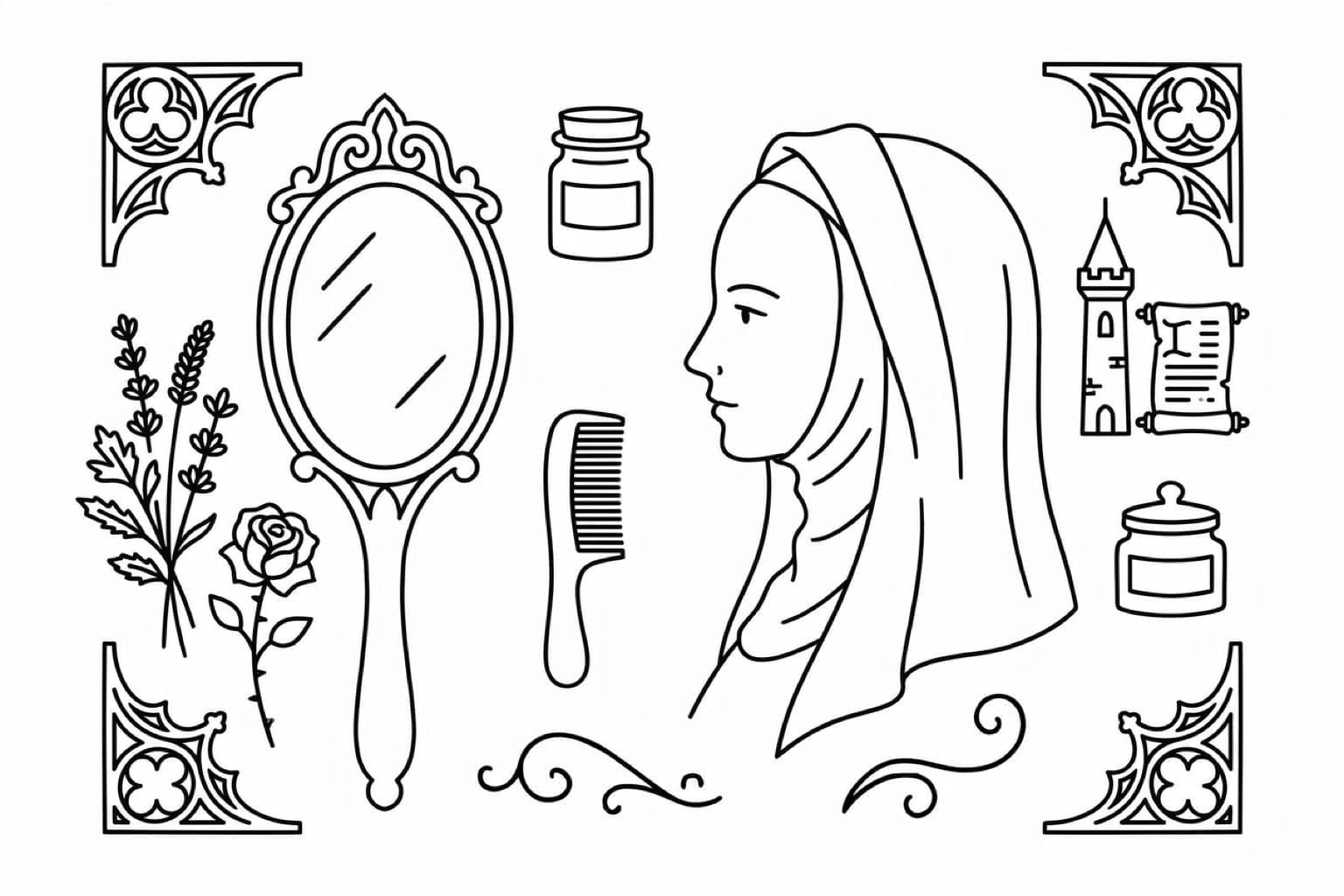
Rosewater, herbs and the art of skincare
If overt makeup lived under suspicion, skincare flourished. This is where I think the medieval contribution is genuinely impressive and most relevant to how we work today.
Rosewater was the great staple — a fragrant infusion used to cleanse, tone and refresh the skin, valued as much for its scent as its supposed virtues. Around it sat a whole repertoire of herbal preparations: infusions and washes to soothe and brighten, salves and ointments to treat blemishes and dryness, and distillations of flowers and herbs prized for their cleansing properties.
Bathing and washing, contrary to the persistent myth of the filthy medieval, were part of the regime for those who could manage them, and the care of the complexion was treated as a serious, ongoing discipline. Much of this drew on a rich tradition of herbal and folk knowledge, passed between women and refined over generations.
The mindset underneath is one I recognise instantly. Treat the skin as the canvas; prepare it patiently; let good condition do most of the work before any colour is added. Strip away the dubious ingredients and a medieval skincare routine is not so far from the prep I do before a wedding or a shoot. The principle endures: healthy, well-tended skin is the foundation on which everything else sits.
The idealised lady of courtly love
Beauty ideals do not float free of culture, and the medieval ideal was bound up with one of the era’s most powerful inventions: courtly love.
From the twelfth century, the literature of chivalry and romance elevated a particular vision of the noble lady — distant, refined, almost unattainable, the object of a knight’s devotion and longing. Poets and troubadours sang her praises, and in doing so they fixed an aesthetic. The idealised lady had skin white as snow or lilies, cheeks lightly touched with rose, golden hair, a high clear brow and an air of serene, untouchable grace.
This was an aspirational image, and real women measured themselves against it. The plucked hairline, the pale face, the faint flush — all of it gestured toward the lady of the poems. Cosmetic practice and literary fantasy fed one another. It is a pattern we still live with: the idealised face of an age is shaped as much by its stories and images as by anything practical, and women navigate the gap between the ideal and the everyday.
What the books actually said
We are not guessing about all of this. Medieval medical and herbal texts preserved real cosmetic knowledge, and the most famous of these deserves special mention.
The Trotula — a collection of writings on women’s medicine associated with the renowned medical school at Salerno in southern Italy — included substantial material on women’s cosmetics: how to whiten the skin, treat blemishes, care for the hair, redden the lips and cheeks, and generally tend to the appearance. That such guidance sat within a respected medical tradition tells us something important. Cosmetic care was understood, at least in some learned circles, as a legitimate part of women’s health and wellbeing, not merely a frivolous indulgence — even as moralists thundered against vanity from the other direction.
This double life is the heart of the medieval beauty story. On one side, sermons condemning the painted face. On the other, medical texts calmly cataloguing recipes for a fairer complexion. Women lived in the space between, taking what was useful and defensible and leaving the rest unspoken.
Class and region, once more
It bears repeating that this knowledge was unevenly distributed. The cosmetic and skincare practices preserved in texts like the Trotula, and the leisure to pursue them, belonged largely to women of means in the more sophisticated courts and towns. For most women, beauty care meant whatever simple, local, herbal remedies were to hand. The polished ideal of the high forehead and luminous skin was, in practice, a privilege of rank as much as a fashion.
From restraint to spectacle
Here is the part that fascinates me as much as the medieval look itself: what came next.
Centuries of moralised restraint built up a kind of pressure. The medieval ideal was all about concealment — artifice pretending to be nature, colour so subtle it could be denied. When the Renaissance arrived, bringing new wealth, new confidence, renewed contact with the classical past and a more theatrical visual culture, beauty swung hard in the opposite direction. Artifice stopped apologising for itself.
The result was the bold, unmistakably painted face of the courts that followed — the dazzling, openly constructed look that reached its zenith in the elaborate artifice of the Tudor era, with its stark white complexion and deliberate, performed beauty. The plucked high forehead actually carried over for a time, a direct medieval inheritance, but the spirit had changed completely. Where the medieval lady whispered, her Renaissance descendant announced. Restraint had set the stage for spectacle.
That swing between concealment and display is one of the oldest rhythms in beauty, and the medieval-to-Renaissance turn is one of its clearest examples. Understanding where a look comes from genuinely changes how I approach my own work — whether I’m building a soft, luminous bridal complexion or a bolder period-inspired look. If you’d like to talk through a look that draws on this kind of history, that conversation is exactly what my makeup services are for.
Conclusion
The medieval centuries are often dismissed as a blank in the story of beauty — a long, pious pause between the painted faces of antiquity and the spectacle of the Renaissance. They were nothing of the sort. They were a sophisticated, constrained, deeply human chapter in which women pursued a demanding ideal under real moral pressure: pale and luminous skin, a high domed forehead won by plucking the hairline, faint brows, and the most discreet whisper of colour on cheek and lip.
What strikes me most is the resourcefulness of it all. Working with wheat flour and egg white, rosewater and herbal infusions — and, more dangerously, with white lead — medieval women built a beauty culture that prized clear, well-tended skin above everything, even as the Church branded their efforts as deceit and vanity. The skincare instinct at the centre of it is one I share completely: prepare the canvas, and the rest follows.
And there is a lesson in the way it ended. A thousand years of restraint did not extinguish the desire to enhance and adorn — it merely held it down until it burst out, more theatrical than ever. Beauty, it turns out, is not so easily preached out of existence. It adapts, it goes quiet, it finds its loopholes, and sooner or later it returns in full colour.