1920s Flapper Makeup: The Roaring Twenties Beauty Revolution
The 1920s broke every rule — dark smoky eyes, cupid's-bow lips and powdered pallor turned makeup into a public statement of the modern, liberated woman.
Few decades transformed a woman’s face as completely — or as deliberately — as the 1920s. In the space of a few short years, makeup leapt from a private vice whispered about behind closed doors to a glittering public ritual, snapped open from a metal compact at a café table for all the world to see. The flapper, with her cropped bob, her kohl-rimmed eyes and her tiny crimson mouth, wasn’t simply following fashion; she was wearing her independence on her face. As a makeup artist working in London today, I find myself returning to this era constantly — for Gatsby parties, for editorial shoots, for anyone who wants to borrow a little of that fearless 1920s glamour. Here is how that revolution actually happened, and how to recreate it.
A face shaped by war and freedom
To understand flapper makeup, you have to understand what came before it. The Edwardian ideal, which I’ve written about in more depth in my piece on Edwardian beauty, prized a soft, natural, almost untouched look — pale skin, rosebud lips and the studied appearance of a woman who would never dream of visibly painting her face. Cosmetics existed, certainly, but a respectable lady applied them so subtly that the goal was to look as though she wore nothing at all.
The First World War shattered that genteel world. With men away at the front, women poured into factories, offices, hospitals and transport networks, earning their own wages and discovering a freedom their mothers had never known. When the men returned, that genie would not go back into the bottle. The mood of the 1920s — the Jazz Age, the Roaring Twenties — was one of release: a generation that had survived war and the 1918 influenza pandemic wanted to dance, to drink, to live loudly. Makeup became part of that exhilarated, slightly defiant spirit.
Suffrage and the ‘New Woman’
The political backdrop matters enormously. In Britain, the Representation of the People Act 1918 granted the vote to women over thirty who met a property qualification, and in 1928 the franchise was finally extended to all women over twenty-one on equal terms with men. This hard-won enfranchisement helped give shape to the so-called ‘New Woman’ and her younger, more rebellious sister, the flapper — a young woman who bobbed her hair, shortened her skirts, smoked in public, and used cosmetics openly. The flapper’s painted face was, in its own way, a small political act: a refusal to be modest, demure and invisible.
When makeup walked out in public
This is the single most important shift of the decade, and it’s easy to overlook from a modern vantage point. Before the 1920s, makeup carried a faint whiff of disrepute — heavy paint was associated with actresses and prostitutes, and a respectable woman simply did not retouch her face where others could see. The 1920s blew that taboo apart.
The arrival of the portable, mirrored metal compact was central to this. Suddenly a woman could carry her powder and rouge in her handbag and, in a gesture that would have appalled her grandmother, snap it open in a restaurant, a theatre foyer or a railway carriage to powder her nose and reapply her lipstick. Applying lipstick in public became a deliberate piece of theatre — a way of announcing that you were a modern woman who had nothing to hide. The swivel-up metal lipstick tube, patented in the United States in 1923, made the gesture quick and elegant, and the cosmetics counter moved decisively out of the chemist’s back room and into the bright, mirrored department store.
The wider story of how attitudes to cosmetics shifted across the centuries sits within my broader survey of makeup history, but no decade did more to make the painted face respectable than this one.
The flapper face, decoded
So what did the look actually consist of? It was a striking, high-contrast, almost mask-like face — the deliberate opposite of the natural Edwardian ideal — and every element played a role.
Powdered pallor
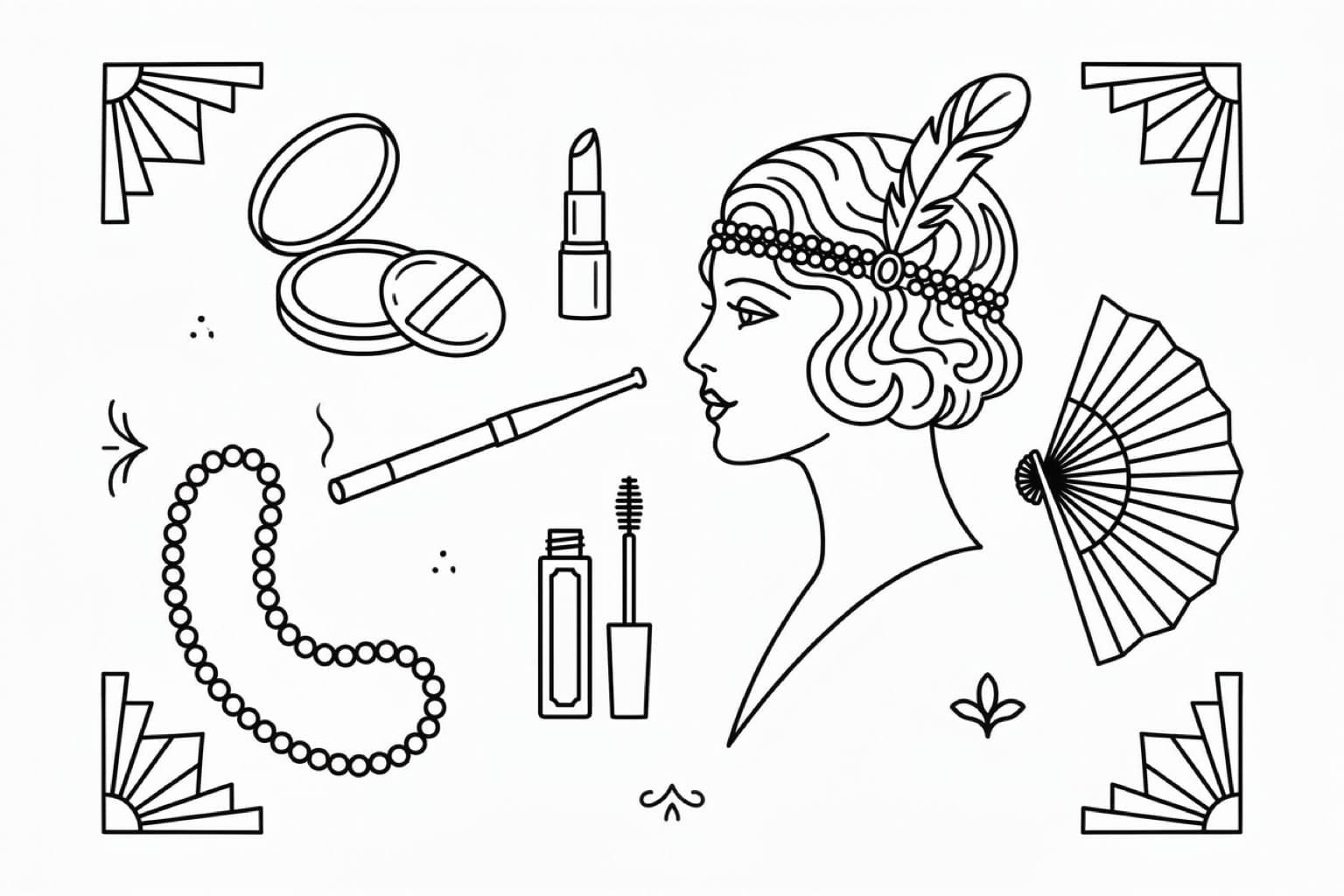
The foundation, quite literally, was pale skin. A fashionable 1920s complexion was matte and powdered to a porcelain or even slightly ghostly finish. A tan was still considered common, the mark of someone who laboured outdoors, so women used face powders in pale, pinkish and ivory tones, sometimes with a hint of green or lavender to neutralise any ruddiness. The aim was a smooth, uniform, almost theatrical pallor that made the dark eyes and dark lips read all the more dramatically against it.
Dark, smoky, doe-eyed eyes
The eyes were the heart of the flapper face, and they were heavy. Women rimmed their eyes top and bottom with dark kohl, then smudged it deliberately into a soft, smoky halo. The shape was rounded and slightly drooping at the outer corners — a soulful, doe-eyed, almost melancholy effect, quite different from the sharp winged liner that would come later. Greys, browns, charcoals, and even dramatic greens, blues and plums were brushed across the lids, often blended up and outward and smudged underneath so the eye looked large, dark and dreamy.
The story of how the eye became the focal point of the face — and how techniques evolved from this smudged kohl to precise modern liner — is one I trace in my guide to the evolution of eye makeup. The 1920s was the moment the smoky eye truly arrived.
Thin, drawn-on brows
Brows were plucked to a fine line and frequently drawn back in with pencil, extended downward at the outer edges into a long, low, slightly mournful curve. This downturned brow, paired with the rounded smoky eye, gave many flappers that characteristic wistful, hooded expression you see in period photographs.
The cupid’s bow and bee-stung lips
Then there were the lips — perhaps the most recognisable flapper signature of all. The fashion was for a small, exaggerated mouth: women would powder over the natural lip line and redraw a tiny, sharply peaked cupid’s bow in the centre, often deliberately painting inside their natural lip line to make the mouth look smaller, fuller and more pouting. This ‘bee-stung’ or ‘rosebud’ shape, in deep, vivid colours — dark cherry reds, brick, oxblood and plummy purples — was the finishing punctuation mark on the whole face.
Rouge with a flush
Cream and powder rouge added a flush of colour high on the cheeks. Earlier in the decade it was often applied quite high and round, almost in a circle below the eye, before settling into a softer placement along the cheekbone. Combined with the pale powder and dark features, it completed a face that was unmistakably, proudly made up.
Cinema, vamps and the women who set the style
You cannot tell the story of 1920s makeup without the silver screen. This was the golden age of silent film, and because actors couldn’t use their voices, everything was communicated through the face — which meant makeup had to be bold enough to register on a flickering black-and-white screen and in the back row of a vast picture palace. Audiences then carried those looks home and copied them.
Three names defined the era. Theda Bara had, a little earlier, originated the screen ‘vamp’ — the dangerous, exotic, heavily kohled seductress whose smouldering, dark-eyed image set the template for cinematic glamour. Clara Bow, the original ‘It Girl’, gave the decade its definitive flapper face: that small, heart-shaped cupid’s-bow mouth, the smudged dark eyes and the tumble of red curls. And Louise Brooks, with her sleek, jet-black bob and pale, knowing face, became the era’s most enduring style icon — her look is the one most people still picture when they imagine the twenties.
These stars didn’t just reflect fashion; they manufactured it. A new mouth shape or eye treatment on screen could be on faces across London within months. That direct line from cinema to the cosmetics counter only intensified as the decade turned into the studio-polished perfection of the next era, which I explore in my piece on 1930s Hollywood glamour.
Max Factor and the birth of ‘make-up’
If the stars sold the look, it was a Polish-born immigrant to Hollywood who engineered it. Max Factor had trained working with cosmetics and wigs in Russia before settling in California, where he built his business serving the film industry. He is widely credited with popularising the very term ‘make-up’ — derived from the theatrical phrase ‘to make up’ one’s face — and helping shift it from backstage jargon into everyday language.
Factor’s genius was developing cosmetics that worked under harsh studio lighting and on film, then translating those professional products for ordinary women who wanted to look like their favourite actresses. His tinted ‘Color Harmony’ approach — matching powder, rouge and lip colour to a woman’s individual colouring — was genuinely ahead of its time, and his salon became a place where ordinary Angelenos could be made up like the stars. The aspirational link he forged between the screen and the dressing table is still, in a sense, the model the entire beauty industry runs on today.
The cosmetics industry comes of age
The 1920s is when makeup became big business. Demand created by the war, by cinema and by the newly liberated public-wearing of cosmetics turned a cottage trade into a thriving modern industry, complete with national advertising, branded packaging and mass production.
A few developments stand out:
- The metal compact became both a practical tool and a fashion accessory in its own right — engraved, enamelled, sometimes jewelled — designed to be seen as much as used.
- Cream rouge and improved powders gave a smoother, more blendable finish than the cruder paints of earlier decades.
- Cake mascara — applied with a little brush and water, or spit, onto a hard block of pigment — let women darken and define their lashes at home. The brand we now know as Maybelline was founded in 1915 (its name famously tied to a young woman called Mabel and the petroleum jelly Vaseline), and through the 1920s it helped bring eye cosmetics to a mass market for the first time.
- The swivel lipstick tube turned lip colour into a portable, glamorous everyday object rather than a fiddly pot.
Names that still sit on shop shelves today — Maybelline, Max Factor, Elizabeth Arden, Helena Rubinstein — were established or rose to prominence in this period, building the commercial scaffolding of modern beauty.
Hair, silhouette and the whole modern woman
Makeup never existed in isolation, and the flapper face only makes sense as part of a complete, radically modern silhouette. The defining gesture was the bob — hair cut short and blunt to the jaw, sometimes shingled or Eton-cropped even shorter, a style that horrified traditionalists precisely because it so clearly rejected the long, pinned-up Victorian and Edwardian feminine ideal.
That sleek, geometric head of hair framed the powdered face beautifully, drawing all attention to the eyes and mouth. Add the dropped-waist, straight-cut dresses that flattened the bust and skimmed past the natural waist, the shortened hemlines, the long ropes of beads and the cloche hat pulled low over the brow, and you have a total look. The flapper’s makeup was the focal point of a coherent design — a face built to be read across a crowded, smoke-filled dance floor.
Recreating the flapper look today
This is where the history becomes practical, because a 1920s look is one of the most requested briefs in my London diary — for Gatsby-themed parties, vintage weddings, jazz nights and period shoots. The key decision is always the same: do you want an authentic recreation or a modernised interpretation?
The authentic approach
For a faithful 1920s face, I lean into the contrast that defined the era:
- A pale, matte, evenly powdered complexion — a shade or two lighter than usual, kept resolutely shine-free.
- A genuinely smoky, rounded eye in charcoal, grey-brown or smudged black kohl, blended top and bottom, deliberately soft rather than sharp, with the outer corner pulled gently down and out.
- Fine, low, slightly downturned brows — often the hardest sell for a modern client used to full, brushed-up brows.
- A small, dark cupid’s-bow mouth in oxblood, brick or plum, with the lip line redrawn just inside the natural edge for that bee-stung effect.
- A soft flush of rouge set fairly high on the cheek.
The modernised approach
Most clients want the spirit of the twenties without the more challenging period details — and that’s perfectly valid. Here I keep the smoky eye and the bold, dark lip but adapt the rest to flatter a contemporary face: a healthy, slightly luminous skin rather than stark pallor; natural, full brows left as they are; and a lip drawn to the client’s real lip line rather than shrunk inward. The result reads unmistakably as ‘twenties’ in photographs while still looking like them. For editorial makeup — shoots, Gatsby events and period campaigns — I’ll often push the authentic version harder, because a camera and good lighting reward that high-contrast drama in a way everyday wear does not.
A few practical tips, whichever route you take: use a long-wearing, properly pigmented dark lipstick and blot it well, because that small painted mouth is the first thing to smudge over a long evening of talking and dancing. Set the smoky eye carefully — kohl was meant to look a little smudged in the twenties, but there’s a difference between artful softness and a panda by midnight. And finish with plenty of powder; the flapper face was never dewy.
Conclusion
The 1920s did something no decade had managed before: it made the act of wearing makeup not just acceptable but admirable, a visible badge of the modern, independent woman. The pale powder, the smudged dark eyes and the tiny crimson cupid’s bow weren’t merely a fashion — they were the face of a generation that had earned the vote, taken up work, cut off its hair and decided, emphatically, to be seen.
What I love most about this era is how completely it reinvented the relationship between a woman and her reflection. The compact snapped open in public, the lipstick reapplied without apology, the bold eye that asked to be looked at — these were quiet declarations of freedom, and they laid the foundations for everything the beauty industry became. Every smoky eye and every swivel lipstick tube on the market today carries a little of that twenties DNA.
So when a client asks me for a flapper look, I never treat it as mere costume. Recreating that face — whether faithfully or with a modern twist — is a way of stepping into one of the most exhilarating moments in beauty’s story, when a generation of women picked up their kohl and their crimson and, for the first time, painted exactly the face they wanted the world to see.