1930s Hollywood Glamour: Old Hollywood Makeup and the Silver Screen
In the 1930s, Hollywood set the standard — pencil-thin brows, glossy lips and luminous skin built for black-and-white film by makeup pioneers like Max Factor.
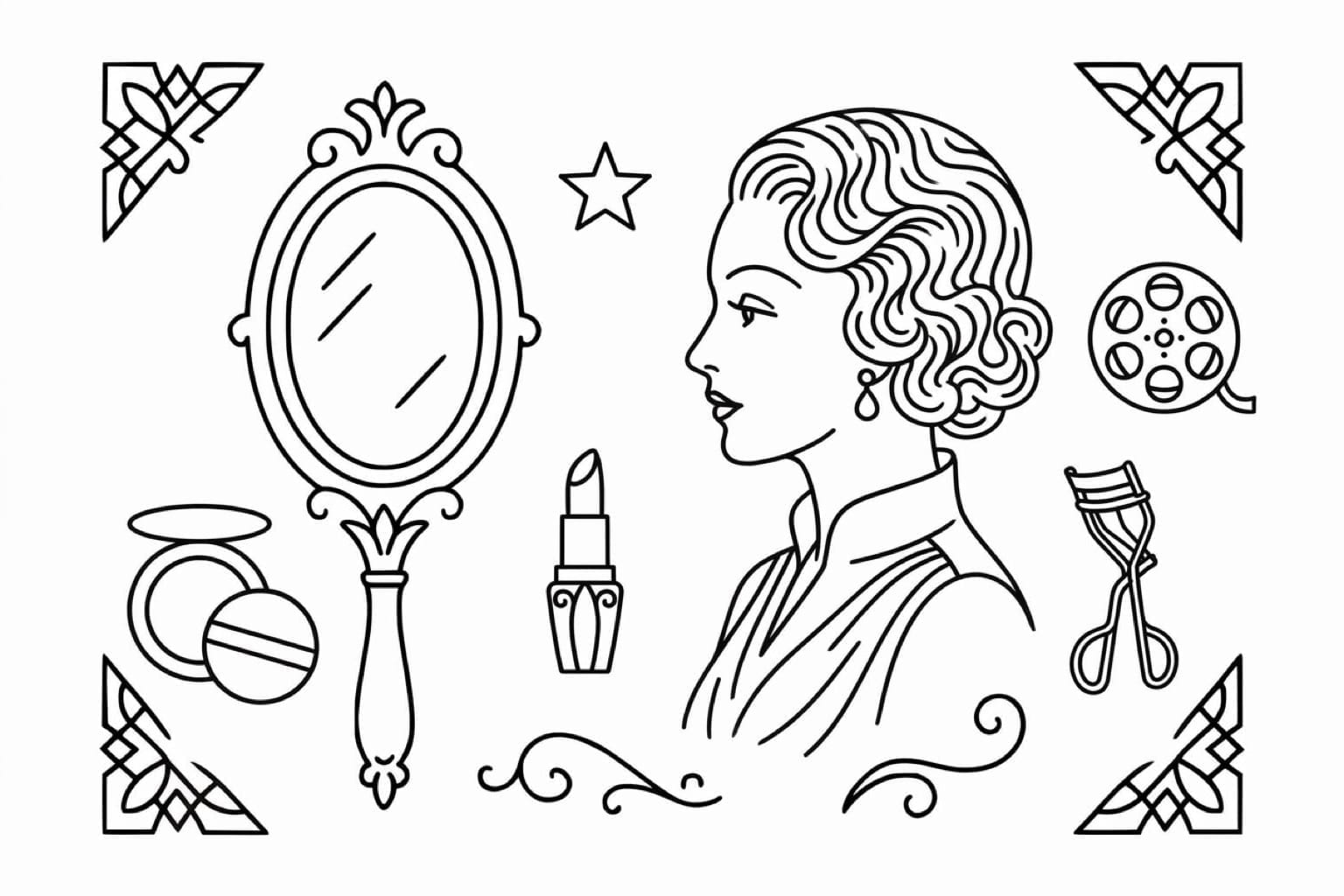
There is a particular kind of light that belongs to the 1930s — soft, sculpted, almost liquid across the skin — and even now, when a client sits in my chair and asks for “Old Hollywood”, that is the light they are reaching for. They may not know the names of the women who built it, or the chemist who engineered the face to catch it, but they recognise the effect instantly: a luminous complexion, a brow drawn with cool precision, a mouth painted into a soft, satin bow. The look feels effortless. It was anything but. The glamour of the silver screen was a manufactured language, invented in studio dressing rooms and laboratories to survive the unforgiving eye of black-and-white film — and it still shapes how we do red-carpet beauty today.
Glamour as Escape: Beauty in the Depression Era
To understand the look, you have to understand the decade that produced it. The 1930s in Britain and America were defined by the Great Depression — mass unemployment, shuttered businesses, and a daily life stripped of luxury for millions of people. And yet this was the golden age of cinema. For the price of a ticket, an ordinary woman could sit in the dark and watch a goddess descend a marble staircase in satin and diamonds. The contrast was the point. Hollywood sold escapism, and beauty was central to the fantasy.
This was a sharp pivot away from the deliberately boyish, androgynous spirit of the previous decade. If you have read about 1920s flapper makeup, you will remember the dark, kohl-rimmed eyes, the small rosebud “Cupid’s bow” lip, and the rejection of curves in favour of a flat, youthful silhouette. The 1930s softened all of it. The boyish flapper grew up into a woman — elegant, poised, unmistakably glamorous. Femininity came back into fashion, and the face followed.
The Studio Star System and the Manufacture of Beauty
Nothing about a 1930s star was accidental. The major studios — MGM, Paramount, Warner Bros — operated a “star system” in which actors were signed to long contracts and their entire image was controlled by the studio machine. Names were changed, teeth were capped, hairlines were adjusted, and faces were redesigned by the makeup department to fit a marketable ideal.
Crucially, this meant that beauty trends now had a single, enormously powerful source. When a leading lady appeared on screen with a particular brow shape or lip colour, millions of women saw it within weeks. Fan magazines, newspapers and advertising amplified every detail. For the first time in history, beauty was being broadcast at scale — and the studios understood that the woman in the cinema seat wanted to look like the woman on the screen. This is really the beginning of the mass-market beauty aspiration that defines our industry to this day, a thread you can follow across the wider story of makeup history.
Max Factor: The Man Who Built the Face
You cannot tell this story without Max Factor. A Polish-born wig-maker and cosmetician who had worked for the Russian imperial theatre before emigrating to the United States, Factor set up shop in Hollywood and became, effectively, the makeup artist to the entire film industry. His genius was that he treated makeup as a problem of optics and chemistry, not just decoration.
”Make-up” and Colour Harmony
Factor is widely credited with popularising the very word “make-up” as a term for cosmetics — derived from the act of “making up” one’s face. He also developed his “Color Harmony” principles: the idea that a woman’s foundation, blush, lip colour and even hair should be selected as a coordinated palette to suit her individual complexion, hair and eye colouring, rather than chosen at random. It sounds obvious now because it became the foundation of how we are all taught to work, but at the time it was a genuinely new way of thinking about a face as a unified composition.
Pan-Cake for Technicolor
His most famous laboratory breakthrough came at the end of the decade. As film moved towards Technicolor, the heavy greasepaints of the silent era looked thick, shiny and unnatural under the new colour cameras. Factor’s answer was Pan-Cake make-up — a smooth, matte, cream-to-powder foundation applied with a damp sponge that gave even, natural-looking coverage on screen. Developed for Technicolor productions in the late 1930s, it photographed so beautifully that the actresses began quietly taking it home, and when it was released to the public it became one of the best-selling cosmetics in the world. It is the direct ancestor of the modern cream foundation in nearly every professional kit, mine included.
The Society Salon
Factor also opened his celebrated Hollywood “Society Salon”, a glamorous studio where stars were made over and ordinary women could buy into a piece of the magic. It cemented the idea that the techniques used on the screen’s most beautiful faces were available — at least in spirit — to everyone.
Engineering a Face for Black-and-White Film
Here is the part that fascinates me most as a working artist. The signature 1930s look was not designed to be beautiful in person. It was designed to be beautiful through a lens, in black and white, under fierce studio lighting.
Black-and-white film flattens everything into tones of grey. It cannot read colour, only light and shadow, and early film stock distorted certain shades — reds could photograph almost black, while too much shine bounced the lights straight back and washed a face out completely. So the makeup had to be built to control where light fell. Skin was kept matte and even so it read as flawless and “lit from within”. Powder was used generously to kill shine. The whole face became a surface to be sculpted with tone.
This is, quite literally, the birth of contouring for the camera. Artists used pale highlight down the centre of the nose, on the brow bone and the tops of the cheeks to push features forward into the light, and deeper shadow in the hollows of the cheeks and the sides of the nose to carve out structure that the flat film would otherwise lose. They were painting in greyscale before the camera did. If you trace the history of contouring, the 1930s studio floor is where the technique was formalised into something deliberate and repeatable — long before Instagram ever borrowed it.
The Signature Look, Feature by Feature
Brows: Thin, Arched and Often Entirely Drawn On
The brow is the single most recognisable feature of the decade. The 1930s brow was extremely thin, highly arched and elongated, often tapering into a long, downward tail that gave the face a slightly wistful, dramatic expression. Many stars achieved this by shaving or plucking the natural brow away almost entirely and drawing it back on with a pencil, which gave total control over the shape and a clean, graphic line.
It is a look that asks for confidence, and it tells you a great deal about the era’s attitude to artifice: there was no pretence of “natural”. The face was a canvas to be designed. The evolution of the brow — from this drawn-on arch through later, fuller decades — is one of the clearest markers of changing taste in the whole evolution of eye makeup.
Eyes: Defined, Lashed, but Restrained by Today’s Standards
Compared with the smoky 1920s eye, the 1930s eye was softer and more about subtle definition than heavy drama. Artists used neutral or smoky-grey shadow blended into the socket to add depth that the camera could read, a defined upper lash line, and generously curled and darkened lashes — false lashes and beading the lashes with cosmetics were common on set. The aim was wide, expressive, luminous eyes rather than the harsh black rims of the previous decade.
Lips: A Fuller, Satin Bow
The lip grew up too. The tiny pinched rosebud of the flapper gave way to a fuller, more defined mouth with a clear, sculpted bow on the upper lip. Colours were rich and satiny — deep reds and berries that, even reading as dark grey on film, gave the mouth weight and presence. The most famous variation belonged to Joan Crawford, whose makeup artist over-drew her lips well beyond their natural line into a bold, full shape nicknamed the “Hunter’s bow” — an early, very deliberate piece of lip over-lining that we still do on the red carpet today.
The Icons Who Set the Standard
Beauty trends in the 1930s had faces, and those faces became templates that women copied directly.
- Jean Harlow — the original “Blonde Bombshell”, whose icy platinum hair (achieved with a punishing peroxide and ammonia process) launched a worldwide craze and made platinum blonde shorthand for glamour itself.
- Greta Garbo — remote, luminous and impossibly elegant, with thin arched brows and beautifully sculpted, shadowed eyes; her face is almost a manifesto for the decade’s lighting-led approach.
- Marlene Dietrich — perhaps the most knowing of them all about the camera. She famously used a fine line of white highlight down the centre of her nose, plucked her brows into a high arch, and is often said to have shaded beneath her cheekbones to exaggerate them. She understood the optics as well as any artist on the lot.
- Joan Crawford — those over-drawn “Hunter’s bow” lips and strong, expressive brows made her one of the most imitated faces in the world.
- Carole Lombard — the luminous, sophisticated blonde of screwball comedy, whose polished, glowing complexion was a masterclass in the “lit-from-within” finish.
These women were not simply photographed beautifully. They were collaborating, knowingly, in the construction of an ideal — and audiences treated them as the authority on how a modern woman should look.
Hair: Finger Waves and Sleek Sophistication
Makeup never lives alone, and the 1930s face was framed by hair that matched its mood. The sculpted, geometric finger waves and pin curls of the era gave hair the same sense of controlled, glossy perfection as the skin. Styles were sleeker and a touch longer and softer than the severe flapper bob, often set close to the head in deep, polished waves that caught the light. The overall silhouette was smooth, refined and immaculate — every element, from the wave at the temple to the arch of the brow, working as one composed image.
From the Silver Screen to the Magazine Rack
It is worth pausing on how this beauty reached real women, because it changed the industry permanently. Cinema gave the look its glamour, but fan magazines, women’s weeklies and a booming cosmetics advertising industry turned it into something you could buy and recreate at your own dressing table. Brands sold lipsticks and powders explicitly by association with the stars, and Max Factor’s own products carried the implicit promise that you could wear the same makeup as the women on the screen. The modern machinery of beauty marketing — aspiration, celebrity endorsement, the coordinated product range — was essentially assembled in this decade. The disciplined, screen-ready glamour of the 1930s would later soften and humanise into the more wearable elegance of the post-war beauty years, but the commercial template never went away.
Recreating Old Hollywood Glamour Today
When I build an Old Hollywood face now, I am working from this exact playbook, adapted for high-definition cameras and modern skin-first finishes. The brow is the one thing I rarely copy literally — very few clients want a shaved-and-drawn 1930s arch — so I groom and define rather than recreate. But everything else translates beautifully: a luminous, evenly toned complexion; soft, deliberate contour to sculpt the cheekbones and nose; a defined, gently smoked eye with a lifted, beautifully curled lash; and a satin red or berry lip with a precise, slightly fuller bow. It remains one of the most requested and most flattering looks I do, especially for black-tie events, vintage-themed weddings and any moment that calls for genuine drama. It is also a staple of editorial makeup, where a single perfectly lit Old Hollywood portrait can carry an entire shoot — proof that a face engineered for 1930s film cameras still photographs like a dream nearly a century on.
Conclusion
The 1930s gave us more than a pretty look. It gave us the idea that a face could be designed — engineered for light, broadcast to millions, and sold back to ordinary women as an attainable dream. Max Factor’s “Color Harmony”, his Pan-Cake foundation and his Society Salon turned makeup from a private vanity into a professional craft and a global industry, while the studio star system gave that craft its irresistible faces.
What I love about the period is how much of it survives in my own kit and my own hands. Every time I sculpt a cheekbone with highlight and shadow, balance a complexion to read flawless under a flash, or over-line a lip just so, I am drawing on techniques perfected on a 1930s soundstage. The brows have changed and the film stock is long gone, but the ambition is identical: to catch the light beautifully.
So when a client asks for Old Hollywood glamour, I take it as a real brief, not a costume. It is a discipline with a century of craft behind it — and getting it right means honouring both the artistry of the women who wore it first and the chemist who taught a whole industry how to build a face for the camera.