Edwardian Beauty and the Gibson Girl: Glamour at the Turn of the Century
Between Victorian restraint and the Roaring Twenties, the Edwardian era softened beauty into the Gibson Girl ideal — luminous skin, full hair and a gentler glamour.
There is a particular kind of beauty I find myself returning to again and again in my work — soft, luminous, unhurried, the sort that looks less like makeup and more like a woman simply caught in flattering light. When I trace that aesthetic back through the history of our craft, it leads me straight to the Edwardian era, those gilded years either side of 1900 when British beauty exhaled after decades of Victorian severity but had not yet learned to be loud. It was the age of the Gibson Girl, the picture hat and the dewy complexion; an age when cosmetics were still whispered about rather than worn openly, yet the foundations of the entire modern beauty industry were quietly being laid. Let me take you there.
La Belle Époque and the Reign of Edward VII
The Edwardian era takes its name from King Edward VII, who reigned from 1901 to 1910, though most historians stretch the period’s cultural reach to the outbreak of the First World War in 1914. After the long, sombre widowhood of Queen Victoria, Edward — by then a worldly, pleasure-loving man in his sixties — ushered in a mood of relative gaiety, fashion and indulgence. On the Continent the French called these years La Belle Époque, the beautiful age: a time of garden parties, theatre, motor cars, electric light and a confident, prosperous upper class with the leisure to think about appearance.
It is easy to over-romanticise it. This glittering surface sat atop deep inequality, and the “bloom” so prized in fashionable women was largely a privilege of class. But for the story of makeup, what matters is the shift in feeling. Where the Victorian beauty ideal had been built on pallor, modesty and moral suspicion of cosmetics, the Edwardians allowed themselves a gentler, warmer glamour. Beauty was still meant to look natural and virtuous — but it could now look healthy, radiant and just a little knowing. That subtle loosening is, to my eye, the true beginning of modern beauty culture.
The Gibson Girl: An Ideal Drawn into Being
No single image defined Edwardian beauty more completely than the Gibson Girl, the creation of the American illustrator Charles Dana Gibson. From the 1890s and through the 1900s, Gibson’s pen-and-ink drawings appeared in magazines on both sides of the Atlantic, and the woman he sketched became the era’s reigning template — perhaps the first true mass-media beauty ideal, decades before the cinema or the cover girl.
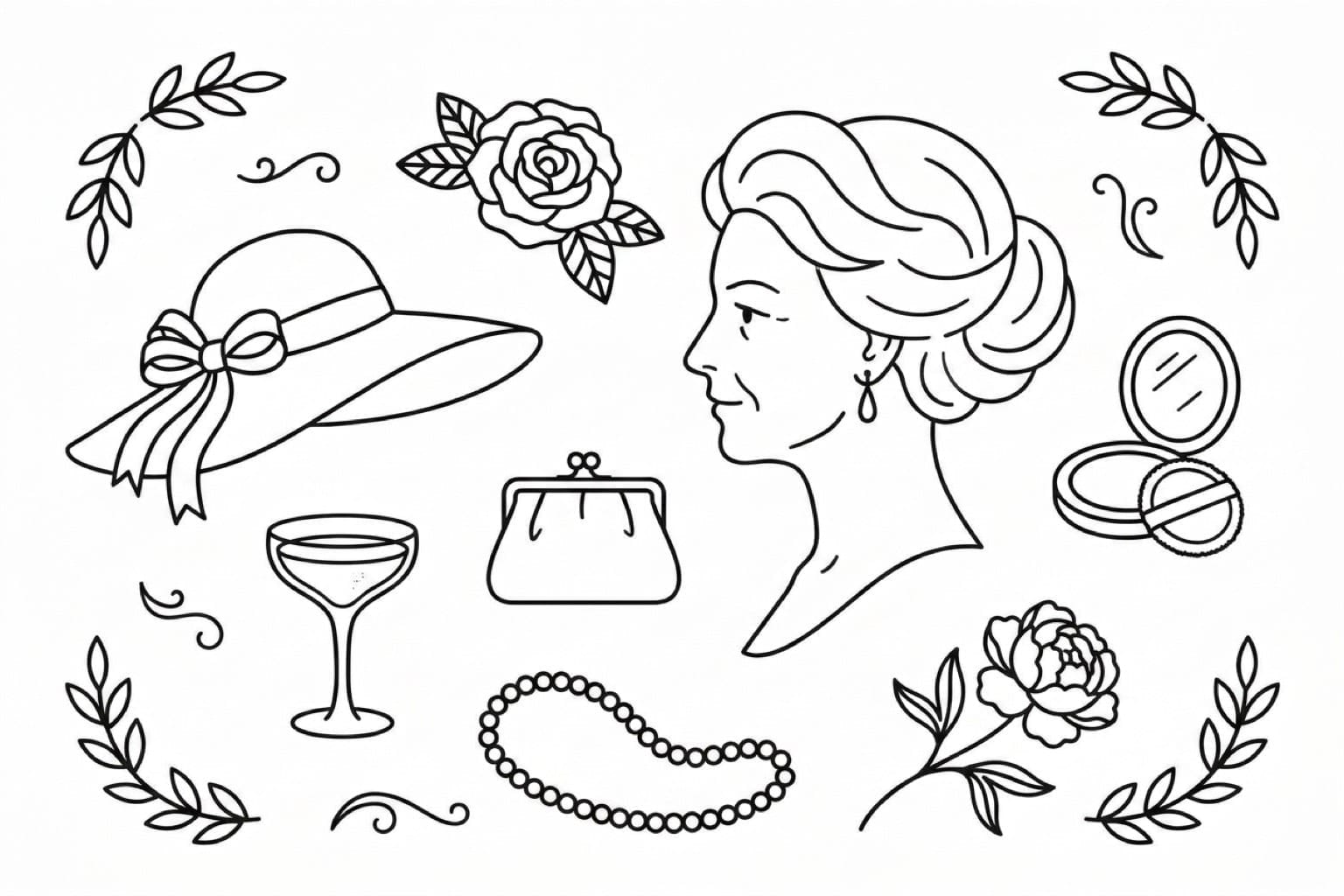
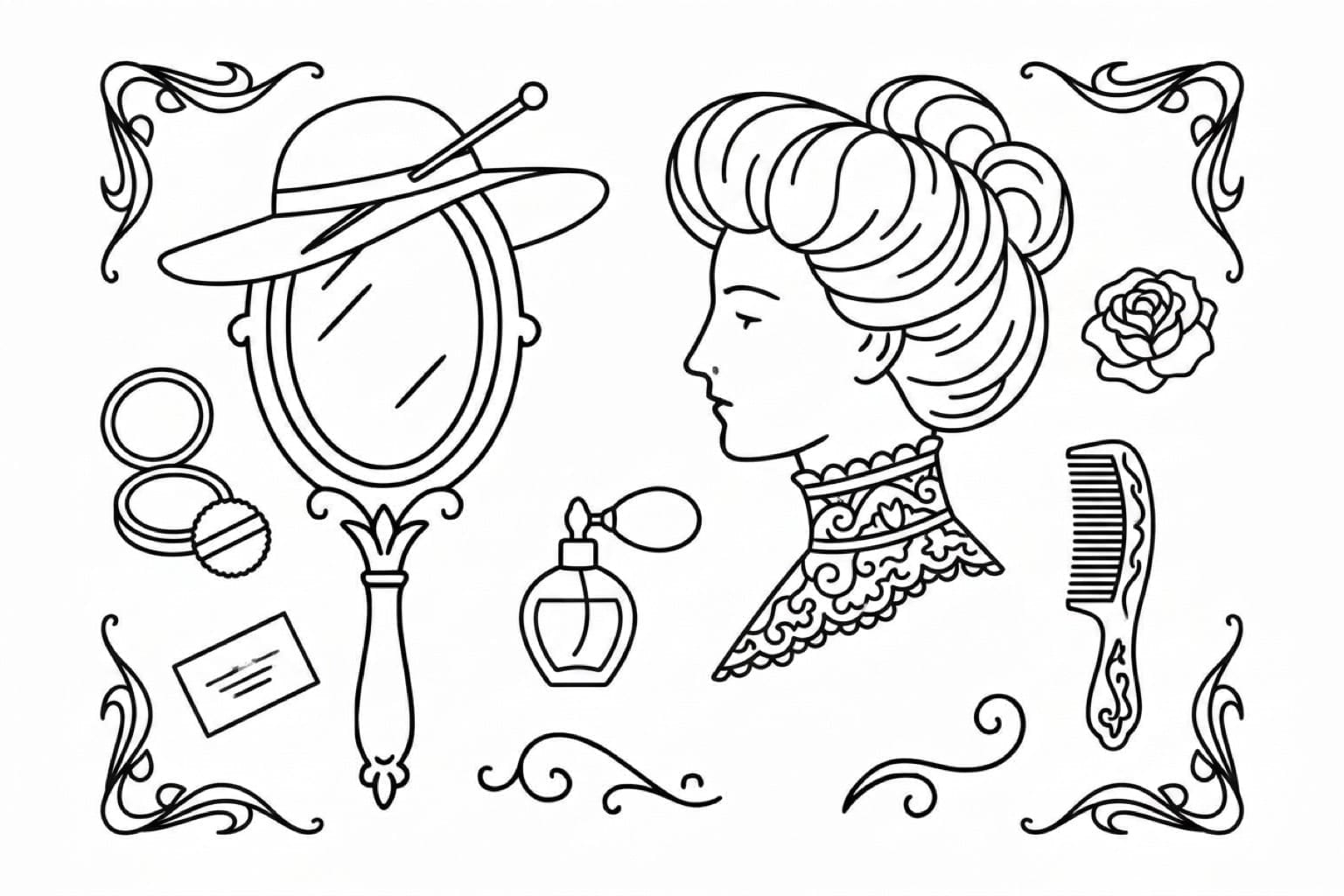
What did she look like? Tall and statuesque, with a long, swan-like neck held high. Her expression was serene, faintly amused, self-possessed. Her hair was piled into a soft, full pompadour that framed the face like a halo. Her waist was tiny, her bust full, her posture an unmistakable S-curve. She was athletic enough to play tennis or ride a bicycle, yet unfailingly elegant — aspirational rather than attainable. Crucially, the Gibson Girl wore almost no visible makeup at all. Her beauty was meant to read as a gift of breeding and health: clear skin, bright eyes, a faint natural flush. That illusion of effortlessness was, of course, the result of a great deal of effort, and understanding how that effort was achieved tells us almost everything about Edwardian cosmetics.
The S-bend silhouette
The Gibson Girl’s famous S-shape was sculpted by the so-called “health” or S-bend corset, fashionable in the early 1900s. Marketed — somewhat ironically — as healthier than earlier styles because it relieved pressure on the abdomen, it instead thrust the bust forward and the hips back, forcing that distinctive curve. The body, like the face, was being shaped towards an ideal of soft, abundant femininity. It is worth remembering that the Edwardian look was a whole-figure aesthetic: the makeup, the hair, the corset and the gown all worked together, and no element makes complete sense in isolation.
Makeup, Still Spoken of in Whispers
Here is the paradox at the heart of Edwardian beauty: cosmetics were more available, more sophisticated and more widely used than ever before, yet they remained, officially, improper. Visible “paint” still carried a whiff of the stage or the street. A respectable lady was not supposed to look made up. The art lay entirely in concealment — of the artifice itself.
So the Edwardian beauty arsenal was deliberately subtle:
- Pale powder, usually rice powder or finely milled starches, to set the complexion to a soft, matte evenness. A touch of papier poudré — little books of powdered tissue paper — could be carried in a reticule and pressed discreetly against a shiny nose.
- A hint of rouge, applied so lightly it suggested a natural blush rather than colour. Cream rouges and liquid tints were preferred for their seamless finish; the goal was to mimic the flush of fresh air and good health, never to announce itself.
- Lip salves and tinted balms, which conditioned and gave a faint rosy stain. Bold, defined lipstick lay decades in the future; the Edwardian lip was soft, moist and barely there. For the longer arc of how the mouth went from this shy salve to a defining feature, I always point readers to the evolution of lipstick.
- Eyebrow and lash care — a little petroleum jelly or castor oil to darken and define, perhaps a whisper of burnt cork or kohl among the bolder set, though heavy eye colour remained firmly the territory of actresses.
The watchword was invisible enhancement. If anyone could tell you were wearing it, you had failed. That principle, incidentally, is one I still teach in soft-glam and natural bridal work today — the most flattering makeup often looks like no makeup at all.
The Cult of the Complexion
If the Edwardian lady downplayed colour, she lavished attention on skin. The era was obsessed with the complexion — the famous “bloom of youth” — and this is where the beauty routine genuinely flourished. Clear, smooth, luminous skin was the prize, and an entire culture of creams, lotions, tonics and treatments grew up to chase it.
Freckles, tan and any sign of weathering were considered blemishes to be faded, since pale unmarked skin still signalled a life of leisure indoors rather than labour in the sun. Women applied cucumber lotions, buttermilk, glycerine and rosewater, lemon washes and a parade of “complexion soaps”. Ponds, which had begun in the nineteenth century as a medicinal extract, was evolving towards the cold cream and vanishing cream that would make it a household name. Cleansing, softening and protecting the skin became a nightly ritual — the direct ancestor of the multi-step skincare routines we treat as modern.
I find this part of the story rather lovely, and rather instructive. The Edwardians understood something we sometimes forget in an age of full-coverage everything: that genuine radiance is built on the skin itself, not painted over it. When I prep a complexion for a luminous, dewy finish, I am, in a sense, working in a tradition more than a century old. For the longer view of how these attitudes evolved across the decades, the history of makeup overview sets the wider stage.
The Birth of the Modern Beauty Industry
For all that cosmetics were still officially frowned upon, the Edwardian years were the very moment the modern beauty business was born — a fact I never tire of pointing out, because the contrast is so striking. Behind the discreet powder and the talk of complexions, a commercial revolution was beginning.
Several names that still sit on counters today trace their origins to this exact window. Helena Rubinstein, having found success with her skin creams in Australia, opened her London salon around 1908, bringing a scientific, treatment-led approach to skincare. Elizabeth Arden opened her first salon on New York’s Fifth Avenue in 1910, with its famous red door, building a brand on cleanliness, refinement and respectability — exactly the qualities that made cosmetics acceptable to genteel women. Across the country, Max Factor, a Polish émigré, was establishing himself in America and would soon transform makeup for the new film industry. In France, François Coty was turning perfume into a modern luxury good, his fragrances among the era’s most coveted.
What united these pioneers was a shrewd insight: by framing beauty products as matters of hygiene, science and self-respect rather than vanity or seduction, they made cosmetics safe for the respectable middle-class woman to buy. The dedicated beauty counter, the branded jar, the salon treatment, the trained consultant — the entire architecture of how we shop for beauty today began taking shape in these years. The Edwardians may have whispered about makeup, but they were quietly building the industry that would let the next generation shout about it.
Professional Beauties and the Power of the Postcard
Who decided what beautiful looked like? In the Edwardian era, increasingly, it was a new kind of celebrity. The late Victorian and Edwardian period gave us the “Professional Beauties” — society women and, especially, actresses whose faces were famous in their own right. Their photographs were sold as collectable postcards by the million, pinned up, swapped and admired, making them the influencers of their day.
Stars of the British stage such as Lillie Langtry — already a celebrated beauty and, notably, an early endorser of Pears soap — along with Gaiety Theatre actresses and singers like Camille Clifford, who was hailed as a living embodiment of the Gibson Girl, shaped what women aspired to. Their hairstyles were copied, their complexions studied, their poise imitated. And because these women were photographed and reproduced endlessly, beauty became, for the first time, something you could see standardised and circulated on a mass scale.
This matters enormously for the history of makeup. Actresses were among the few women who could wear visible cosmetics without scandal — it was their profession — and so they quietly normalised it. The stage was a laboratory where bolder looks could be trialled before they trickled, much softened, into respectable life. That dynamic, of performers leading and the public cautiously following, would only accelerate as the cinema arrived.
Hair, Hats and the Architecture of Glamour
You cannot speak of Edwardian beauty and stop at the face; the face was framed by some of the most elaborate hair and headwear in fashion history. The pompadour — hair swept up and out from the forehead, full and soft around the crown — was the signature style. To achieve its volume, women padded their own hair over wire frames or pads (charmingly nicknamed “rats”), and supplemented it with false switches and pieces. The effect was a luxuriant, cloud-like mass that balanced the body’s S-curve and gave the whole silhouette its romantic proportion.
Atop this rose the picture hat: broad-brimmed, extravagantly trimmed with silk, ribbon, flowers and — controversially even then — great sweeps of feathers and sometimes whole birds. These hats were enormous, anchored with long decorative pins, and they completed the era’s theatrical, sweeping glamour. Beauty, in the Edwardian sense, was a total composition. The soft, glowing face was the still centre of an elaborate frame of hair and millinery, and the restraint of the makeup makes far more sense when you picture it surrounded by all that abundance. A made-up face would have been one ornament too many.
Lipstick, the Vote and the Stirrings of Change
Beneath the gentility, the ground was shifting. The Edwardian era was also the height of the suffrage movement, and in a development I find genuinely fascinating, cosmetics — especially lip colour — became quietly entangled with women’s independence. There is a well-documented episode in which the American beauty entrepreneur Elizabeth Arden handed out red lipstick to suffragettes marching in New York around 1912, and the bold red lip became something of a badge among campaigners on both sides of the Atlantic — a small, visible act of defiance against the notion that respectable women must be demure and unpainted.
It was a perfect symbol. To wear visible colour was to claim ownership of one’s own face and appearance, to step out of the role of the passive, ornamental Gibson Girl and into something more self-determined. The seeds of the rebellious, expressive beauty of the next decade were being sown right here, in the supposedly genteel Edwardian years. What had been a whisper was beginning, ever so slightly, to find its voice.
When the World Changed: War and the Road to the Twenties
And then it ended, suddenly and completely. The First World War broke out in 1914, and the comfortable Edwardian world did not survive it. As men went to the front, women stepped into factories, offices, hospitals and farms in unprecedented numbers. The elaborate, dependent femininity of the Gibson Girl — corseted, immobilised, ornamental — became impractical and, increasingly, unwanted. Hair was cut shorter, hemlines rose, corsets loosened and were eventually abandoned, and the entire architecture of Edwardian glamour was swept away.
What emerged on the other side was the modern woman: independent, active, and unapologetic about her makeup. The discreet powder and barely-there bloom gave way to the kohl-rimmed eyes, defined brows and bold cupid’s-bow lips of the 1920s flapper. The cinema, now booming, turned the actresses who had once been postcard curiosities into global icons whose looks millions copied openly. The beauty industry that the Edwardians had so carefully built — Rubinstein, Arden, Factor, Coty, Ponds — was ready and waiting to supply that newly liberated demand. The whisper had become a declaration.
Conclusion
I have a great deal of affection for Edwardian beauty, precisely because it sits at such a poignant hinge in our story. It is the moment our craft began to step out of the shadow of Victorian shame, yet did so on tiptoe, all softness and subtlety and luminous skin. The Gibson Girl was the last great ideal of beauty-as-natural-gift before the twentieth century made beauty something a woman could openly construct for herself. In her serene, dewy face you can see both the modesty she inherited and the confidence she was about to claim.
What keeps that aesthetic alive for me is how completely it speaks to modern soft-glam and, above all, bridal work. The Edwardian principles — radiant skin built from genuine care, a flush that looks like the bride’s own colour, a barely-there lip, makeup so seamless it reads as simply her, at her best — are exactly the principles behind a beautiful, timeless wedding look. When I create that soft, luminous, romantic finish for a bride, I am drawing directly on this turn-of-the-century ideal, and it is precisely the register I aim for in my bridal makeup work.
So the next time you see a portrait of a Gibson Girl, look past the corset and the picture hat to that calm, glowing complexion. There, more than a century ago, you will find the quiet beginnings of the natural, luminous beauty so many of us still long for today — proof that the most enduring glamour has always been the kind that looks like no effort at all.