Pin Up Makeup: The 1950s Bombshell Look and How to Recreate It
The story of 1950s pin up makeup — porcelain skin, the black winged liner, the true-red lip — plus a working MUA's steps to recreate the retro look today.
Few looks have survived as intact as the 1950s pin-up. Nearly seventy years on, a client will still sit down in my chair, show me a photograph of Bettie Page or Marilyn Monroe, and say simply, “I want that.” And I know exactly what she means: the porcelain skin, the softly flushed cheek, the graphic black flick lifting at the outer corner of the eye, and above all the bold red mouth painted into a crisp, confident bow. It is one of the most recognisable faces in the history of beauty — glamorous, playful, unapologetically feminine — and it remains a firm favourite for retro weddings, rockabilly weekenders, vintage photo shoots and anyone who simply wants to feel like a bombshell for the evening. To wear it well, though, it helps to understand where it came from.
Not the Same as the “New Look”: Two Faces of the 1950s
The first thing worth clearing up is that the pin-up is not simply “1950s makeup”. The decade actually held two rather different beauty ideals side by side. On one hand there was the polished, respectable elegance that came in with Christian Dior’s 1947 “New Look” — the nipped waist, the full skirt, the immaculate matte face of the well-groomed housewife and the fashion magazine. That refined, ladylike register is really the mainstream story of the era, and I’ve written about it more fully in the piece on post-war beauty.
The pin-up sat alongside it as something cheekier and more overtly sexual. Where the New Look was about propriety and control, the pin-up was about glamour with a wink — a look descended from wartime “cheesecake” photographs and Hollywood publicity stills, carried forward through the emerging teenage and rockabilly cultures of the fifties. Both faces shared the same building blocks: flawless skin, defined eyes, a strong lip. But the pin-up turned every element up a notch and wore it with a knowing smile. Understanding that distinction is what stops a modern recreation from tipping into either fussy prim-ness or fancy-dress caricature.
Where “Pin-Up” Came From
The term itself is delightfully literal. A “pin-up” was a picture pretty enough to be pinned up on a wall — and the genre really took hold during the Second World War, when illustrated and photographed images of glamorous young women were printed in magazines, on calendars and on the nose-cones of aircraft, and carried by servicemen as morale-boosting reminders of home. The roots reach back further, to the “Gibson Girl” illustrations of the turn of the century and the wartime pin-ups of the 1940s, a story I trace in the article on 1940s makeup.
By the 1950s the pin-up had matured from a wartime pin-board fixture into a full-blown commercial aesthetic. Illustrators such as Gil Elvgren painted idealised, rosy-cheeked sweethearts for advertising and calendars, while photography made real women into stars of the same fantasy. It was helped enormously by the post-war economy: rationing had ended, colour printing was cheap, magazines were booming, and a newly affluent youth culture had money to spend on looking good. Beauty was no longer only aspirational — it was attainable, and heavily marketed.
The Icons Who Defined the Look
No look lives in the abstract; it lives in faces. Three women, more than any others, gave the pin-up its definitive image.
Bettie Page is perhaps the purest pin-up of all. A model from Nashville who became the most photographed woman of the fifties, she brought a distinctive combination of jet-black hair with its trademark blunt fringe, arched dark brows, a precise winged eye and a full red mouth — often paired with a playful, girl-next-door warmth that made the glamour feel approachable rather than untouchable. Her image became so iconic that “Bettie bangs” and the whole rockabilly pin-up revival are still built directly on her template.
Marilyn Monroe took the bombshell to Hollywood’s highest wattage. Platinum blonde where Bettie was raven, she offered the soft, dewy, sleepy-eyed version of the look: luminous skin, a subtly smoky sculpted eye, an immaculate winged liner and that famous glossy red lip. Her beauty spot, high on the left cheek, became one of the most copied features in cosmetic history. Marilyn’s makeup was, in fact, a masterclass in artful construction — a legacy that runs straight back to the studio techniques of the 1930s Hollywood glamour era.
Rita Hayworth, slightly older than the other two and a star of the 1940s who carried her glamour into the fifties, embodied the sultry, sophisticated end of the spectrum: a strong sculpted cheekbone, a lifted brow, a deep red lip and an air of screen-siren command. Together these three women mapped out the whole range of the pin-up, from wholesome to smouldering.
The Signature Elements, One by One
What makes the pin-up so satisfying to recreate is that it is built from a small number of very deliberate parts. Get each one right and the whole thing sings.
The foundation is a flawless, matte, porcelain base — even, poreless and slightly paler than a suntanned modern face, in keeping with the fifties preference for fair, unblemished skin. Onto that goes a soft, warm cheek, blush placed relatively high and blended upward and outward to suggest a fresh flush, plus a gentle, subtle contour to sculpt the cheekbone rather than the heavy carving we associate with contemporary looks. (If you want the longer story of how face-sculpting evolved, I’ve written about the history of contouring.)
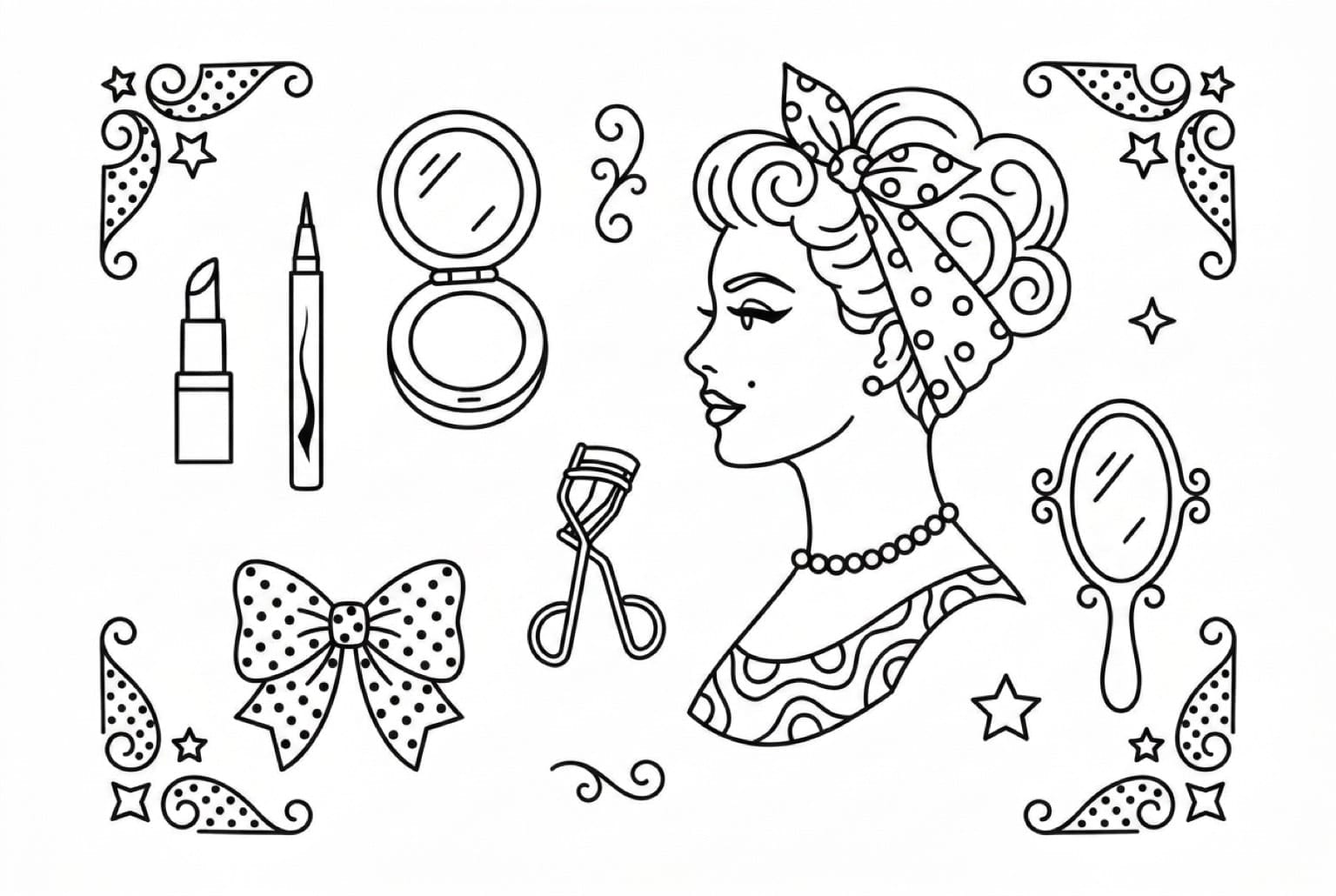
The brow is defined and groomed — fuller and more rounded than the pencil-thin arches of the thirties, with a clear, softly angled shape that frames the eye. The eyes themselves carry the two most important elements: a black winged cat-eye liner, drawn along the upper lash line and flicked up and out at the outer corner in a clean, tapering point, and generous lashes, whether the model’s own well-coated in black mascara or a set of falsies for extra drama. The lower lash line is usually left soft or bare, which keeps the whole eye lifted and wide.
And then, the crown of the look: the bold red lip. This is the element people notice first and remember longest. The fifties favoured a true red or a blue-based red — a cool, vivid crimson rather than a warm brick — painted with a precise, slightly exaggerated cupid’s bow so the mouth reads as full, sharp and immaculately defined. Finally, many wore the beauty spot, a small painted or pencilled mole high on the cheek, popularised by Marilyn and worn as a deliberate flourish. The evolution of these bold, matte reds is a whole subject in itself, which I explore in the piece on the history of lipstick.
Hollywood, Youth Culture and Rockabilly
The pin-up did not spread by accident. Two engines drove it. The first was Hollywood, which by the fifties had perfected the manufacture and broadcasting of glamour; a leading lady’s face was seen by millions and copied within weeks, and the studios sold the products to match. The second, newer engine was youth culture. The 1950s invented the modern teenager as a distinct group with disposable income, its own music, and its own idols — and rock and roll gave that generation a rebellious, sexy visual language.
Rockabilly — the fusion of rock and roll with country and rhythm-and-blues — carried the pin-up out of the calendar and onto real young women who wanted to look like the bombshells they admired. Circle skirts, victory rolls, red lips and winged liner became a subcultural uniform, and it is precisely this thread that has kept the look alive: the rockabilly and vintage scenes never let it die, which is why it feels so wearable and current today rather than like a museum piece. By the end of the decade, though, fashion was already turning: the softer, doe-eyed, paler-lipped ideal that would define the 1960s mod beauty movement was waiting in the wings, and the bombshell would soon step out of the spotlight for a while.
How to Recreate a Modern Pin-Up Look
Here is how I actually build a wearable pin-up when a client asks for it — faithful to the era, but comfortable and photograph-friendly for a real evening.
Start with the skin. Prep and moisturise well, then use a smooth medium-to-full coverage foundation for an even, matte finish. Conceal any redness, and set everything with a light translucent powder — the pin-up base should look poreless and velvety rather than glowing. Keep the shade true to the natural complexion; you don’t want a stripe at the jaw.
Sculpt gently. Add a soft contour under the cheekbone to give shape, then a warm blush placed a touch high and blended up towards the temple for that healthy flush. Keep it subtle; the drama belongs to the eyes and lips.
Groom the brows. Brush them up and fill any gaps to create a clean, defined, softly arched shape — a little fuller than you might wear day-to-day, which balances the strong eye and lip.
Draw the winged liner. This is the technical heart of the look. Use a black liquid or gel liner, keep the line thin at the inner corner and thickening slightly as you move outwards, then flick up towards the tail of the brow and taper to a fine point. My tip: sketch the angle of the wing first with light strokes, get both sides matching, then fill in. A neutral matte lid keeps the focus on the flick. Finish with a couple of coats of black mascara, and add individual or strip falsies if you want the full bombshell.
Perfect the lip. Line the mouth with a red pencil, gently over-drawing the peaks of the cupid’s bow and the fullest part of the lower lip to sharpen and plump the shape. Fill in with a true blue-red lipstick, blot on a tissue, and reapply for staying power. A precise, clean edge is everything here — I often tidy the outline with a little concealer on a fine brush.
Add the finishing flourish. If it suits the client, a tiny beauty spot high on the cheek with a soft brown or black pencil ties the whole thing together. A spritz of setting spray, a set of pin-curls or victory rolls, and the transformation is complete.
Why the Pin-Up Endures
The reason this look refuses to date is that it flatters almost everyone and it carries a mood. A red lip and a lifted eye read as confidence; the porcelain skin and soft cheek keep it pretty rather than harsh; and the whole thing photographs beautifully, which matters enormously in an age when every occasion is documented. It is glamorous without being cold, retro without being costume — provided it is done with a light, modern hand rather than laid on thick. That balance is the difference between looking like a genuine bombshell and looking like a Halloween cliché, and it is the thing I care most about getting right.
A pin-up look is one of my favourite things to create for a vintage-themed wedding, a rockabilly event, a milestone birthday or a retro photo shoot. If you’d love a bombshell face for an occasion of your own, take a look at my special occasions makeup or get in touch to talk it through — makeup is by appointment, and I’ll happily tailor the look to suit you.