1940s Makeup: Beauty, Duty and the Victory Red Lip
How 1940s makeup turned a red lip into a patriotic duty. Wartime rationing, victory rolls, leg makeup and the Hollywood glamour that defied the Blitz.
There is a particular kind of courage in putting on lipstick when the world is falling apart. During the Second World War, that is more or less what the government asked women to do. Amid blackouts, air raids and the grinding shortages of a rationed economy, a carefully made-up face was recast as something close to a patriotic act. 1940s makeup was never simply about vanity. It was framed as morale, discipline and duty, worn by women running factories, driving ambulances and queuing for margarine, all whilst keeping a red lip immaculate. It is one of the most fascinating chapters in beauty history precisely because it was born of scarcity rather than abundance, and its influence still turns up on my chair whenever a bride or a birthday client asks me for something “classic and a little bit vintage”.
Beauty Is Your Duty: Makeup as Morale
By the early 1940s, cosmetics had become entangled with the war effort in a way no one could have predicted a generation earlier. Governments on both sides of the Atlantic actively encouraged women to keep up their appearance. The phrase most associated with this is “Beauty Is Your Duty”, and whilst it was partly a canny bit of marketing on the part of cosmetics houses, it also reflected genuine official thinking. A tidy, cheerful, put-together woman was believed to be good for national morale, good for the men serving overseas who might see her in a photograph, and good for the woman herself as she took on gruelling new roles.
This was a striking reversal. Only decades earlier, in the buttoned-up world of Victorian beauty, visible cosmetics were associated with actresses and women of ill repute, and respectable women went to great lengths to look as though they wore nothing at all. Now the state was practically issuing lipstick as equipment. In Britain, the government considered banning cosmetics production outright to free up resources, then reversed course, having decided that the hit to morale was not worth it. Makeup was rationed and taxed heavily, but it was never entirely taken away.
The Rationing Squeeze and the Ingenuity It Bred
Wartime scarcity shaped every part of the 1940s beauty routine. Raw materials that had once gone into face creams and lipsticks, from petroleum and alcohol to glycerine and metals, were redirected to the war. Cosmetics grew scarce, expensive and, in many cases, simply unavailable. Packaging changed too. Metal lipstick tubes gave way to plastic, paper and cardboard, and women were encouraged to bring their empties back to be refilled rather than throw them away.
What followed was one of the most impressive displays of ingenuity in beauty history. When mascara ran out, women melted down the ends of burnt matches or used boot polish and shoe blacking on a moistened brush. Beetroot juice was pressed into service as a lip and cheek stain when lipstick was unobtainable. Petroleum jelly gave lids a subtle sheen. Cold cream was stretched, rationed and rationed again. This make-do-and-mend spirit was not a fringe eccentricity; it was mainstream, practical advice passed between friends, printed in magazines and shared over garden fences. It gives the whole decade its distinctive character: glamorous in aspiration, thrifty in practice.
The Red Lip That Won the War
If one feature defines the era, it is the bold matte red lip. Far from being frowned upon, red lipstick became a small, portable symbol of defiance and femininity, and the cosmetics houses leaned into the patriotism with gusto. Elizabeth Arden created shades with names engineered for the moment, including Victory Red and Montezuma Red, the latter reportedly developed to complement the uniforms of women in the American armed services. At the more affordable end, Tangee built an entire identity around the idea, its famous orange-toned lipstick advertised as a way to look naturally lovely and morale-boosting rather than painted.
The shades themselves ran from true pillar-box reds to deeper brick and berry tones, always applied to create a full, defined shape. The lip was the anchor of the whole face. You can trace a direct line from these wartime reds through the entire history of the category, and if you enjoy that sort of thing I have written more about it in my piece on the evolution of lipstick. What matters for the Forties is that the red lip did an enormous amount of work: it signalled effort, optimism and self-respect at a time when all three were in short supply.
Max Factor, Pan-Cake and the Matte Complexion
The complexion of the 1940s was smooth, matte and flawless in a very particular, filmic way, and there is a good reason for that. The look came straight off the cinema screen. Max Factor had developed Pan-Cake, a solid, cake-form foundation applied with a damp sponge, originally to solve the problem of how skin read under harsh Technicolor lighting. It gave an even, opaque, shine-free finish that photographed beautifully, and once actresses started smuggling it home from the studios, ordinary women wanted it too. Pan-Cake became one of the fastest-selling cosmetics of its day.
For everyday wear, the aim was clean and even rather than heavily sculpted. Powder kept everything resolutely matte, because shine read as untidy. Cheeks were warmed with a soft wash of rouge, blended high and rounded rather than contoured into sharp angles, and the overall effect was healthy and wholesome. This was a period long before the heavy chiselling we associate with modern makeup, and understanding those foundations of colour and finish is exactly why I still recommend clients read up on the basics of makeup products before a big event, so the vocabulary makes sense when we sit down together.
Arched Brows and Softly Defined Eyes
The eyes of the 1940s were understated by today’s standards, which is part of what makes the look so wearable now. The star of the upper face was the brow. Eyebrows were defined, gently rounded and set in a high, graceful arch, groomed into a clean shape and darkened with a pencil where needed. A strong brow framed the face and lent it a poised, slightly aristocratic composure, balancing the boldness of the red lip below.
Eye makeup itself was soft. Neutral, matte shadows in taupe, brown and grey were smudged lightly over the lid, sometimes with a touch of Vaseline for a subtle gleam on special occasions. Mascara was applied to open the eyes, though never to the dramatic, spidery extremes that would arrive in later decades. Liner, where it was used, was thin and close to the lash line rather than a bold flick. The whole eye was designed to look bright and alert, the face of a woman who was coping admirably, rather than sultry or heavily done.
Legs Without Stockings: Painted Seams and Gravy Browning
No account of 1940s beauty is complete without the great stocking shortage, one of the decade’s most charming and telling stories. Silk and later nylon were requisitioned for parachutes, ropes and other war materials, and hosiery all but vanished from the shops. Bare legs were considered improper for many occasions, so women simply invented an alternative. They painted their legs.
Leg makeup, sold in bottles by the same cosmetics houses, was smoothed over the skin to mimic the colour of stockings. When that ran out, resourceful women used gravy browning, cold tea, cocoa or wet sand to tint their legs a suitably tan shade. The finishing masterstroke was the seam. A friend would take an eyeliner pencil, or a stick of eyebrow pencil, and draw a straight dark line up the back of each calf to imitate the seam of a real stocking. It required a steady hand and a good deal of trust, and it stands as the perfect emblem of the era: a genuine hardship met with a solution that was equal parts practical, sociable and quietly glamorous.
Victory Rolls and the Framing of the Face
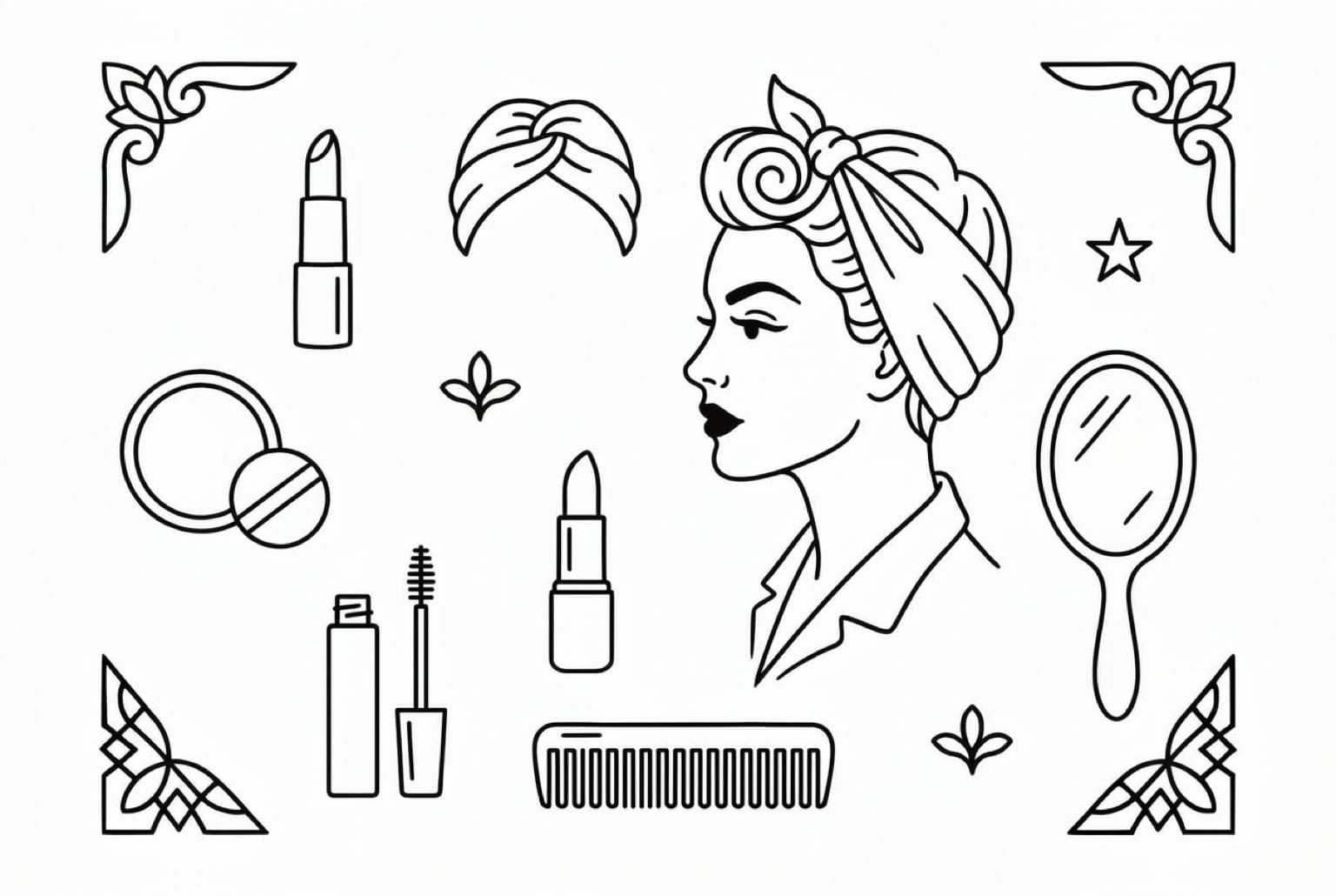
Makeup in the 1940s never worked alone. It sat inside a very deliberate hairstyle, and the two were designed as a single silhouette. The signature is the victory roll, a swept-up, rolled section of hair, usually worn in a pair at the front, curved dramatically away from the face. Practical necessity played its part here too: women working with factory machinery needed their hair up and out of the way, so styles that pinned everything off the face became both safe and fashionable.
The effect on makeup was significant. With the hair lifted and rolled back, the whole face was exposed and framed, which is precisely why the strong brow and the bold lip carried so well. Nothing competed with them. This complete, considered look, hair and face composed as one, is the reason the era reads as so polished in old photographs, and it is the direct ancestor of the pin-up makeup style that grew out of the same period and remains endlessly popular for vintage-themed shoots and events today.
Hollywood’s Grip and the Line Before the New Look
For all the thrift and improvisation, the aspiration was pure Hollywood. Women looked to stars such as Rita Hayworth, Lauren Bacall, Veronica Lake and Ingrid Bergman, and the studios continued to project an image of luminous, immaculate glamour throughout the war. This was the same star-making machinery I have described in my article on 1930s Hollywood glamour, now operating under wartime conditions and quietly setting the standard that ordinary women reached for with their beetroot and their burnt matches.
It is worth drawing a firm line here, because the two are often muddled. The look I have described belongs to the war years and their immediate aftermath: practical, matte, a little austere, defined by scarcity. What came next was something quite different. Once the fighting ended and rationing began to ease, fashion swung hard towards softness, abundance and femininity, culminating in Dior’s celebrated New Look of 1947, with its nipped waists and extravagant skirts. Beauty followed suit, growing gentler, rosier and more romantic. If you want to see where the story goes from here, my piece on postwar beauty picks up exactly at that turning point, and the wider sweep of it all sits in my overview of makeup history.
Recreating the Look Today
The enduring appeal of 1940s makeup is that it was designed to be achievable and it flatters almost everyone. A flawless matte base, a soft rounded cheek, a beautifully groomed arched brow and a confident red lip make a combination that photographs superbly and never looks dated. It is a genuinely wearable piece of history, which is why it comes up so often for vintage weddings, milestone birthdays, themed parties and editorial shoots.
If a Forties-inspired look is what you have in mind, whether it is soft and authentic or turned up for the camera, it is exactly the kind of thing I love to create for special occasions. Do get in touch to talk it through; makeup is by appointment, and I am always happy to help you land on something that feels both true to the era and completely like you.