Beauty in Ancient Greece and Rome: Lead, Lustre and the Classical Ideal
From the Greek cult of natural beauty to Rome's lead-white complexions and elaborate cosmetic rituals, the classical world shaped Western beauty for millennia.
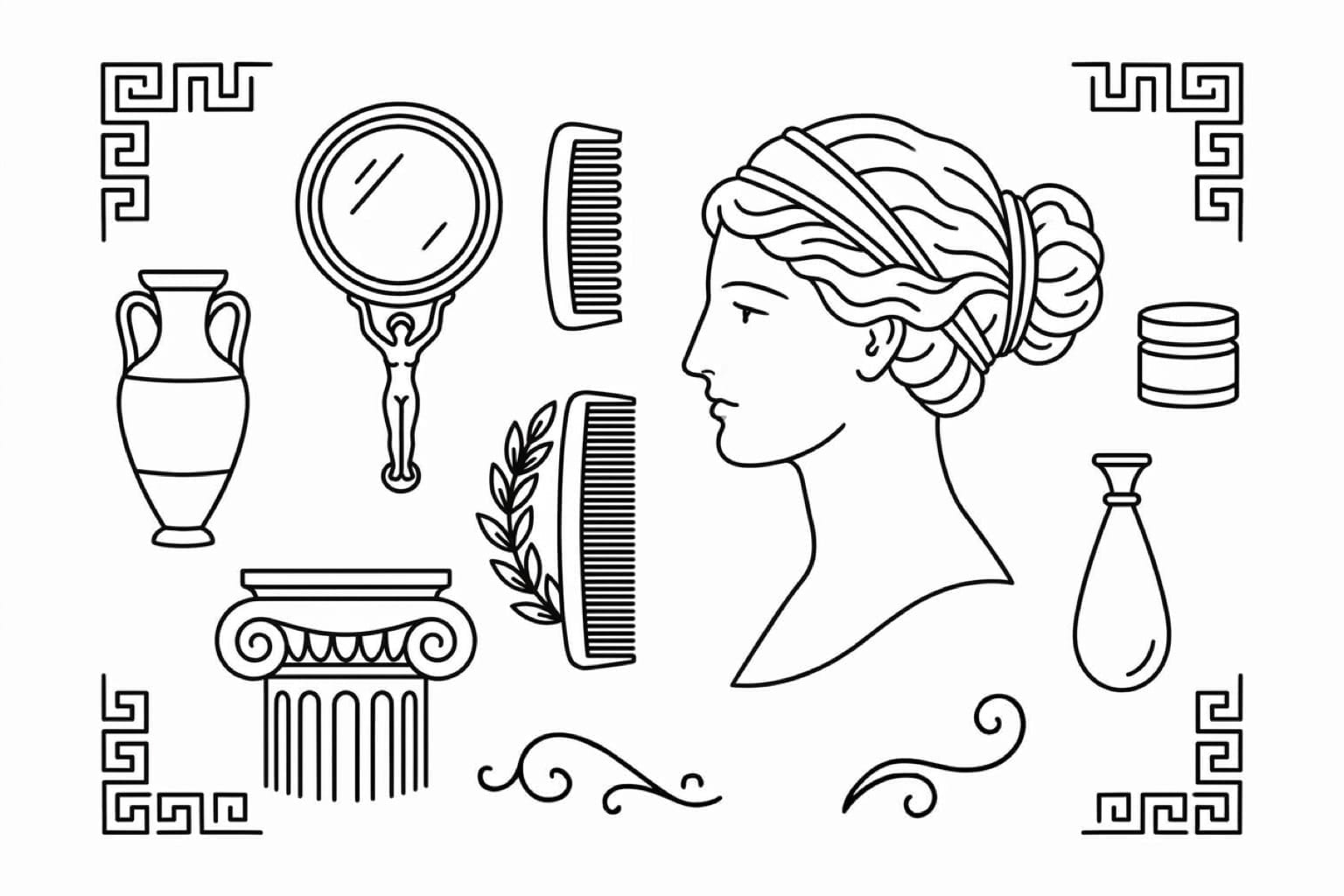
When clients sit in my chair and ask for a ‘no-makeup makeup’ look, they’re asking for something far older than they realise. The idea that the most beautiful face is one that appears untouched by artifice — luminous, even, effortlessly radiant — was already an obsession in the marble courtyards of Athens and the perfumed bathhouses of Rome. The classical world gave us the architecture of Western beauty: its proportions, its prejudices and its quiet hypocrisies. The Greeks insisted they didn’t really wear makeup, then ground white lead onto their skin. The Romans embraced cosmetics with theatrical relish, then mocked the women who used them. Walking through this history, I keep recognising my own profession reflected back at me, two thousand years early.
The Greek Ideal: Beauty as Proportion
To understand Greek cosmetics, you first have to understand what the Greeks thought beauty was. For them, beauty wasn’t a matter of decoration — it was a matter of mathematics. The governing concept was symmetria, a word that meant proportion, harmony and the correct relationship of parts to a whole. A beautiful face was a balanced one: features in measured agreement, nothing in excess. This was the same instinct that produced the proportions of the Parthenon, applied to the human countenance.
Because beauty was understood as inherent order rather than applied colour, the Greek ideal was a natural one — at least in theory. Physical fitness, clear skin, glossy hair and graceful bearing mattered more than paint. The well-born Greek woman was meant to embody sophrosyne, a kind of moderation and self-restraint, and that virtue was supposed to show on an unembellished face. Health was beauty; balance was beauty. Cosmetics, by this logic, were faintly suspect from the very beginning — a theme that, as you’ll see across the whole sweep of makeup history, never entirely goes away.
The trouble, of course, is that nobody actually has a flawless complexion all the time. And so the gap between the ideal of ‘natural’ beauty and the reality of human skin had to be bridged — quietly, deniably — with cosmetics that pretended not to be there.
Pale as Privilege: White Lead and Chalk
The single most prized quality in a Greek woman’s appearance was pale skin. Paleness signalled status: it meant you stayed indoors, that you didn’t labour in the fields or markets under the Mediterranean sun. A fair, untanned complexion was the visible mark of a sheltered, respectable life. Men, by contrast, were expected to be bronzed from the gymnasium and the outdoors. The colour of your skin was, in effect, a social document.
To achieve that coveted pallor, Greek women turned to psimythion — white lead. Manufactured by exposing lead to vinegar fumes and scraping off the resulting white corrosion, this pigment produced a smooth, opaque, luminous whiteness unlike anything else available. It clung beautifully and gave the face an almost porcelain finish. It was also, we now know, a slow poison: chronic lead absorption causes skin damage, infertility, neurological harm and, eventually, death. The very substance used to perform health was quietly destroying it.
Those who couldn’t afford lead, or feared it, used chalk instead — a safer but far less effective whitener that sat dully on the skin and rubbed off easily. The wealthier the woman, the more dangerous and convincing her complexion. It’s a grim equation, and not the last time in this story that the most desirable look carried the highest toxic cost. The hunger for an engineered porcelain skin would echo for centuries, resurfacing dramatically in medieval and later cosmetics.
A Flush of Colour: Rouge from the Garden and the Hillside
Against that white canvas, Greek women added a careful flush to the cheeks and lips — colour meant to suggest the natural bloom of youth and good health rather than obvious paint. The reds came, ingeniously, from the natural world.
- Crushed mulberries lent a soft, fruity stain to lips and cheeks.
- Red ochre, a clay-based mineral pigment, gave a warmer, earthier tone — the same family of iron-rich earth pigments humans have used since the cave-painting era.
- Alkanet, the root known as paideros, yielded a rich red dye prized for rouge.
The cleverness lay in the application. The goal was never the bold, declarative lip we associate with later eras; it was the illusion of natural colour, a deniable warmth that let a woman appear robustly healthy without appearing painted. That tension — between visible artistry and invisible enhancement — is precisely the conversation I have with brides who want to look ‘like themselves, but better’. The Greeks were the first to commercialise that paradox, and the long road from mulberry stain to the modern bullet is worth tracing through the evolution of lipstick.
The Connected Brow and the Darkened Eye
Here is where Greek taste diverges sharply from our own. The classical ideal admired a connected brow — what we’d call a unibrow. Far from plucking the space between the brows into a neat gap, women emphasised it. A continuous dark line above the eyes was considered a mark of beauty and intelligence, and women who weren’t naturally so endowed drew it in, darkening the bridge between the brows with soot or with stibium, a powdered antimony or lead-based compound.
The same dark powders defined and deepened the eyes. This kohl-like rimming and brow-darkening had drifted into Greek practice from older traditions to the east and south, most directly from the kohl-lined eyes of ancient Egyptian makeup, where dark eye paint had served both decorative and protective purposes for millennia. The Greeks adopted the look but bent it to their own aesthetic: a strong, unbroken brow above eyes given gravity by shadow. It’s a useful reminder that brow fashion is among the most volatile things in all of beauty — the feature we now sculpt into arches was, for the classical world, most beautiful when joined.
Oil, Honey and the Cult of the Glow
If there is one through-line connecting Greek beauty to the modern ‘glass skin’ I’m forever being asked to recreate, it’s the obsession with lustre — a healthy sheen on well-tended skin. And here the Greeks were genuinely sophisticated.
Olive oil was the cornerstone of Greek skincare, as it was of Greek life. Massaged into the skin, it softened, protected and conditioned, lending the body a subtle glow. Athletes oiled themselves before exercise and scraped the mixture of oil, sweat and dust away afterwards with a curved tool called a strigil. Honey, with its genuinely humectant and antibacterial properties, featured in face treatments and masks. Beeswax bound salves together; milk, herbs and plant extracts rounded out the repertoire.
What strikes me is how much of this holds up. We now sell olive-derived squalane and honey-based masks at considerable expense, marketing as innovation what the Greeks understood intuitively: that radiant skin is cared-for skin, and that the glow everyone covets comes as much from the surface you build as from anything you paint on top.
Respectable Women and the Suspicion of Paint
For all this craft, there was a persistent moral shadow over Greek cosmetics — and it fell unevenly. The unspoken rule was that respectable, married women should use cosmetics with extreme discretion, if at all. Visible, deliberate makeup was associated less with virtuous wives than with the hetaerae, the educated courtesans who entertained men at symposia and were free to be openly alluring in ways ordinary women were not.
So a wife who painted herself too obviously risked the accusation of deception, vanity, or behaving like a woman of the demimonde. Greek writers fretted about cosmetics as a kind of fraud — a false front presented to a husband. The result was a double bind that women have navigated ever since: be beautiful, but don’t be seen trying; enhance yourself, but never admit the enhancement. The ‘natural’ Greek ideal, it turns out, was less a rejection of makeup than a demand that makeup be perfectly hidden. As a working artist, I find that the most demanding briefs are still the invisible ones.
Rome: Cosmetics as Ritual and Status
Cross the centuries and the sea to Rome, and the temperature changes. The Romans inherited the Greek aesthetic — pale skin, flushed cheeks, defined eyes — but they pursued it with an enthusiasm, an industry and an openness the Greeks would have found slightly scandalous. In Rome, the cultus of beauty became a full-blown ritual, woven into the daily rhythm of the elite household.
The pale ideal persisted, and so did its dangerous instrument: cerussa, Roman lead white, the direct descendant of Greek psimythion. Roman matrons coated their faces in it to achieve the same luminous, status-signalling whiteness, with the same tragic consequences for their health. On top of that base went fucus, the catch-all term for rouge — derived from red ochre, plant dyes, or the costly lichen-based dyes that also coloured fabrics — brushed onto cheeks and lips for a youthful flush.
The eyes received careful attention too. Roman women darkened lashes and lids with soot and with kohl, and they reached for genuine colour on the eyelids: powdered saffron gave a golden-yellow wash, while ash and ground minerals produced smoky and even greenish shades. Malachite and azurite, those gorgeous mineral greens and blues, had long histories as eye colour around the Mediterranean. The Roman eye could be far more painted than the Greek ideal ever officially allowed.
Crocodile Dung and Other Cautionary Tales
No history of Roman beauty is complete without the strange ingredients — and no honest one should repeat them all as fact. So let me sort the credible from the apocryphal.
What’s well attested
- Lanolin — the natural grease from sheep’s wool, called oesypum — was a genuine and effective emollient, used in skin creams and as a base for cosmetics. It remains a real moisturising ingredient today.
- Lead and mercury compounds were genuinely used both as whiteners and in treatments for skin complaints, with predictably ruinous results.
- Vinegar, honey, oils and plant extracts featured in real, recoverable recipes.
What deserves a raised eyebrow
You’ll often read that Roman women smeared crocodile dung on their faces as a beauty treatment. This claim circulates endlessly, but it rests on thin and ambiguous ancient sources and is best treated as a colourful myth rather than established daily practice. Similar caution applies to some of the more lurid ingredients — sweat from gladiators, bizarre animal extracts — that later writers loved to repeat. The Romans were certainly experimental, and some odd substances did find their way into the cosmetic repertoire, but the dung story in particular has been inflated far beyond what the evidence supports. I flag it because beauty history is riddled with these too-good-to-check anecdotes, and an honest account separates the documented from the merely entertaining.
There were also the tooth oddities — Romans used various powders and even, by some accounts, more unsavoury substances as dentifrices and mouthwashes in pursuit of white teeth and fresh breath. The pursuit of the perfect smile, it seems, has always tempted people toward dubious methods.
The Cosmetae and the Morning Toilette
What I find most resonant about Roman beauty is that it was, for the wealthy, a staffed operation. The elaborate morning routine — the toilette — was performed not by the woman alone but with the help of cosmetae, enslaved women who specialised in the application of cosmetics and the dressing of hair. These were, in a very real sense, the first professional makeup artists in the Western record: skilled, specialised and indispensable to their mistress’s public face.
The morning ritual was a production. The skin was cleansed and treated, the lead-white base applied, cheeks and lips rouged, eyes darkened and coloured, hair elaborately arranged and perfumed. Mirrors of polished bronze, pots of pigment, applicators and unguents covered the dressing table. A Roman matron’s reputation depended on appearing in public impeccably finished, and an entire micro-economy of enslaved expertise existed to produce that effect. When I lay out my brushes and palettes before a shoot, I’m performing a recognisable descendant of a ritual two thousand years old — though the labour relations, mercifully, have changed beyond recognition.
Ovid’s Beauty Manual and the Culture of the Bath
Rome even produced the first beauty book we’d recognise as such. The poet Ovid, better known for the Ars Amatoria, wrote a short work called Medicamina Faciei Femineae — ‘Cosmetics for the Female Face’ — offering actual recipes for face treatments and skin preparations alongside his characteristic wit. That a celebrated poet thought facial cosmetics a fit subject for verse tells you how thoroughly beauty culture had permeated Roman society. The text survives only in fragments, but it stands as a genuine ancestor of every beauty guide and tutorial that followed.
Underpinning all of this was the great Roman institution of the bath. The public thermae were not merely for washing; they were centres of grooming, socialising and self-presentation. Bathers were oiled, scraped clean with strigils, massaged, depilated and perfumed. Bathing was where the canvas was prepared — the clean, conditioned, fragrant skin onto which the day’s cosmetics would later go. The Roman relationship with cleanliness and skincare was, in its scale and ambition, something the modern wellness industry has only recently rediscovered.
The Poison Beneath the Polish
It would be wrong to close without dwelling on the cost. The luminous classical complexion was built, again and again, on lead and mercury. Psimythion, cerussa and their mercury-based cousins were absorbed through the skin day after day, year after year. The toll was real: skin eruptions, hair loss, tremors, infertility, madness and early death. In a bitter irony, the cosmetics used to perform radiant health steadily eroded the real thing, and the cheap chalk that was safer simply didn’t deliver the look. Women were, in effect, asked to choose between appearing beautiful and remaining well.
This is the darkest thread the classical world hands down to us, and it doesn’t end with Rome. The lead-white face would return in the Renaissance and the eighteenth century with the same lethal logic intact. Only modern toxicology and regulation finally broke the spell. When I reassure a client that the products on my kit are skin-safe and tested, I’m standing at the far end of a very long and very costly lesson.
Conclusion
The Greeks and Romans bequeathed to the West an ideal we are still negotiating today: skin that is pale, luminous and apparently effortless, with colour so subtly placed it reads as nature rather than art. The Greeks expressed this as the cult of ‘natural’ beauty grounded in symmetria and moderation — even as they quietly ground white lead onto their faces and drew in the brows nature hadn’t joined. The Romans took the same ideal and made it a public ritual: staffed, written about, perfumed and performed, with all the openness the Greeks had carefully suppressed.
What unites them, and connects them to my own work, is the enduring fantasy of the effortless glow — the belief that the most beautiful face is one that doesn’t appear to have been worked on at all. Every ‘no-makeup makeup’ brief, every quest for glass skin, every plea to ‘just even me out and make it look natural’ is a direct inheritance from these ancient courtyards and bathhouses. The technology has changed; the longing has not.
If you’d like to explore that classical ideal of luminous, effortless skin in person — for a wedding, an event or a portrait — I’d love to help you achieve it safely and beautifully through my makeup services. Two thousand years on, the goal is much the same as it ever was. The difference is that now, at last, we can chase the glow without paying for it in lead.