Natural Wedding Makeup: How to Look Like Yourself on Your Wedding Day
Natural wedding makeup from a London bridal makeup artist — luminous, skin-first looks that last all day, photograph beautifully and still look like you.
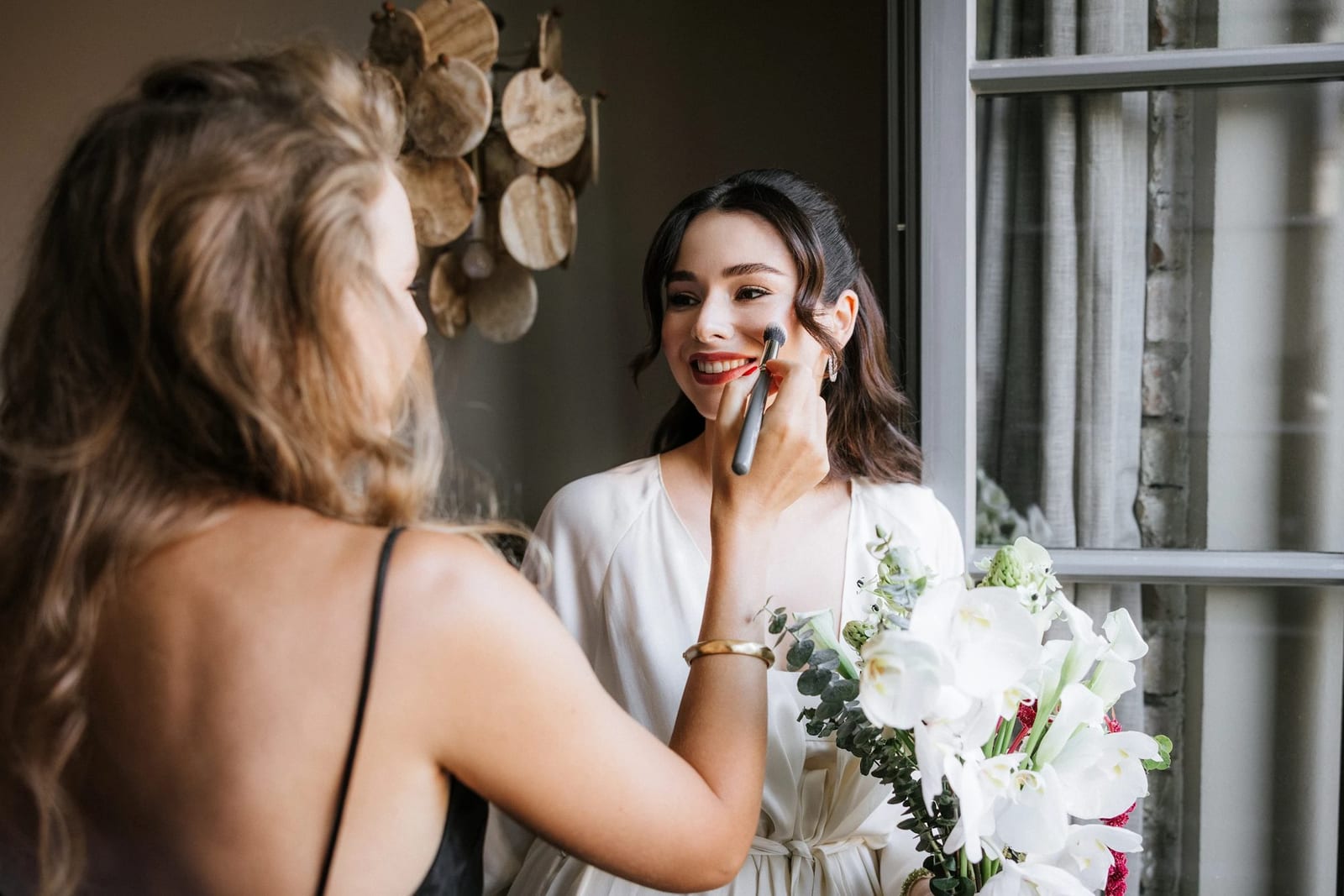
Of all the briefs a makeup artist can be handed, the one brides give most often sounds the easiest: “I still want to look like me.” It is, in truth, the most demanding brief I know. Natural wedding makeup has to achieve everything a dramatic look achieves — staying flawless from an early-morning start to the last dance, holding together through happy tears and a hundred hugs, reading beautifully in photographs taken centimetres from your face — while appearing to do almost nothing at all. There is no smoky eye to pull focus from the base, no statement lip to carry the composition. Just you, seemingly untouched, in front of more cameras than you will ever face again in a single day. This guide gathers what natural bridal makeup across London has taught me: why the barely-there brief calls for the most technique, how longevity is engineered into a light look, what changes when the wedding is small or the ceremony is a registry office, and how to work out where you belong on the spectrum of wedding makeup styles — so that when your partner turns around at the top of the aisle, they see precisely the person they proposed to.
Why “just like me, but better” is the hardest brief in makeup
Heavier makeup is, strangely, more forgiving. A bold evening look announces itself as makeup, and the eye accepts it on those terms — a slightly stronger line or a firmer contour simply belongs to the genre. Natural wedding makeup makes a far riskier claim: that this is simply your face. The moment one element rings false, the whole claim falls apart. A foundation half a shade too warm stops being skin and becomes a layer. Blush placed a centimetre too low drags the face instead of lifting it. A brow taken one degree too sharp turns “groomed” into “drawn”. With so little product on the face, every decision is visible — which means every decision has to be right.
Then add the stakes. On an ordinary Tuesday, nobody studies your face for long, and a small miscalculation is forgotten by lunchtime. On your wedding day, the people who love you most look at you closely for hours, a professional photographer studies you through a lens that flatters nothing, and the results hang on walls for decades. Natural bridal makeup is precision work performed under the closest scrutiny a face will ever meet. I don’t say that to alarm you — it is simply the reason I give this brief more preparation, more testing and more time than any other, and why I encourage every bride who wants a natural look to treat it as a considered project rather than a morning-of decision.
What a barely-there look has to survive
Consider the actual shape of a wedding day. Makeup often goes on before ten in the morning; the last photographs may be taken close to midnight. In between sit a ceremony where you will very possibly cry, a receiving line of embraces and kissed cheeks, confetti, wind, a warm dining room, speeches that set you off all over again, and several hours of dancing. Fourteen hours is a serious ask of any makeup. It is an enormous ask of makeup designed to look like it isn’t there.
The camera adds its own demands. Wedding photography is shot close and printed large, so anything heavy shows as texture — but anything too timid simply disappears. A white dress behaves like a giant reflector, bouncing light up into the face; it brightens beautifully, but it also drains colour, and a genuinely bare face can look tired next to all that glowing fabric. This is the central paradox of the style: natural wedding makeup looks are always a little more than they appear. A touch more blush than everyday, a whisper more definition at the lash line, warmth returned to exactly the places a long day and a bright dress will steal it from — all calibrated so that in the final image it reads as nothing but a lovely face.
Endurance, meanwhile, is designed in from the beginning rather than patched on later. Skin is prepared so the base has something to grip. Colour goes on in fine, flexible layers that move with the face instead of sitting on top of it. The lash line — where tears actually gather — is secured with waterproof formulas even when the rest of the eye stays soft. The lip is built in stages so it comes through the toast, the cake and a great deal of kissing with its shape intact. None of this is visible in the finished look, which is entirely the point.
Skin first: the quiet philosophy behind the base
A natural look is won or lost at the level of skin, and that work starts before I ever open my kit. In the weeks before the wedding I ask brides to keep their skincare consistent and hydrating rather than experimental — the run-up to a wedding is no time to introduce your face to something new. On the morning itself, a few minutes of facial massage gets everything moving so the skin arrives at the makeup plump and awake; if you enjoy tools, my notes on gua sha and face rollers before makeup cover the simple pre-makeup ritual I recommend.
The base itself follows one rule: coverage is placed, never poured. I match undertone exactly — this is where most home applications quietly fail — and then conceal only where the eye needs calm: a little around the nose, a considered amount under the eyes, a small correction here and there. The rest of the face keeps its own life. Freckles stay. The natural flush of the cheek is enhanced rather than blanked out and repainted. Luminosity goes on the high points where light would land anyway, not across the whole face. My test is conversational distance: standing as close as your partner will stand during the vows, your skin should look like skin — soft, lit from within, recognisably yours.
The trial: where a natural look is actually designed
Something years of trials have taught me: “natural” means something different on every face that asks for it. For one bride it means brows, curled lashes and a tinted balm. For another it means a full, carefully sheered base, gentle sculpting and a nude lip — a look with a dozen steps that presents as none. Neither is wrong; they are simply different definitions, and the only way to find yours is to build it, on you, and test it.
That is what a bridal makeup trial is for, and for a natural brief I consider it close to essential. At a trial we translate the word into decisions: how sheer the base can go on your particular skin, how much definition your eyes need before they hold their own in photographs, which precise pink your cheeks produce on their own so we can match it rather than argue with it. I photograph the look in daylight and indoors, close up and at a distance, because a natural makeup look for a wedding must convince in pixels as well as in person. Then you wear it for the rest of the day and report back: how it felt at hour one and hour seven, what you caught yourself liking in the mirror, anything that felt like someone else. The refinements that come out of that conversation are the difference between a look that is nearly you and one that is exactly you.
Simple wedding makeup for registry offices and intimate days
Some of the loveliest weddings I work on have twenty guests, a registry office at eleven and a long lunch afterwards — and they deserve their own section, because simple wedding makeup is not a scaled-down version of the big-wedding brief. It is its own discipline, with its own logic.
At an intimate wedding the scrutiny is closer, not lighter. There is no distance, no dim ballroom, no candlelight to soften anything: your guests sit a metre away across a lunch table, the photography is candid and close, and a late-morning ceremony happens in daylight, which is honest to a fault. What flatters here is polish rather than production: skin perfected but sheer, brows softly framed, a lifted, curled lash instead of anything dramatic, a wash of quiet colour through the socket, and a lip with slightly more presence than you would wear on a weekday — because in candid photographs, the lip does a surprising amount of the smiling.
Simple bridal makeup also suits the occasions themselves. A chic suit or a midi dress asks for a different register than a cathedral gown, and a bride marrying later in life — or celebrating a marriage the second time around — often wants elegance without ceremony. What simple must never mean is fragile: a small wedding contains exactly the same tears, hugs and champagne as a large one, so the same engineering goes on underneath. And because I work mobile across London, the morning stays gentle — I come to wherever you are getting ready with the full kit, you have your coffee while I work, and you leave for the ceremony rather than rushing across town from a salon chair.
Wedding makeup styles: where natural sits on the spectrum
It helps to see natural as one point on a spectrum rather than a category of its own. At the quiet end sits the natural look we have been discussing. In the middle sits classic bridal makeup — the timeless album look: a fine line at the lashes, a sculpted but neutral cheek, a rose or soft coral lip, everything defined and nothing trend-led. Classic is the style that looks as right in thirty years as it does on the day, which is why it has never really gone anywhere. Beyond it sits soft glam — a fuller lash, a deeper blended crease, more luminosity through the skin — the dressed-up end of bridal, made for black-tie weddings and grand venues without tipping into evening drama.
Choosing between them is less about fashion than about three anchors. The first is your everyday relationship with makeup: if you rarely wear it, classic can feel like fancy dress, and if you wear a full face daily, strict natural can leave you feeling oddly underdressed at your own wedding. The second is the day itself — the formality of the dress, the scale of the venue, whether the light will be garden-soft or chandelier-sharp. The third is the photography: documentary-style photographers flatter the natural end of the spectrum, while posed, editorial photography rewards a little more structure. You can see these registers side by side in my portfolio — and it is worth knowing the spectrum isn’t fixed for the whole day. Plenty of my brides marry in a natural look and slide towards classic by evening with nothing more than a deepened lash line and a stronger lip.
Bridesmaids and mothers in the same soft register
Group photographs read best when everyone shares a register but nobody wears a uniform. When a bride chooses a natural direction, I usually carry the same soft, luminous language across the whole party — then tailor it face by face, because the entire point of natural makeup is that it belongs to the person wearing it. One bridesmaid’s version leans warmer, another’s cooler; one needs her eyes brought forward, another her skin calmed. In the album, the party looks harmonious and the bride reads clearly at the centre, which is exactly the hierarchy a wedding photograph wants. I’ve written separately about how I approach bridesmaid makeup so the group feels considered rather than conveyor-belt.
Mothers deserve a special word, because the natural register is particularly kind to them. A skin-first approach — sheer, luminous, carefully placed — flatters skin that has changed over the years far better than heavy coverage does, and it photographs wonderfully beside the bride without ever competing. My guide to mother of the bride makeup goes through that morning in detail — where she fits in the schedule, and how her look is built to survive at least as many tears as the bride’s.
Thinking of doing your own wedding makeup?
You will get a balanced answer from me rather than a sales pitch. For a small, relaxed day, a bride with a confident hand and a settled routine can absolutely do her own makeup — nobody knows your face better than you do, and there is something quietly lovely about that. But go in with clear eyes about the conditions. A wedding morning is not your bathroom on a calm Saturday: it is interruptions, adrenaline, a ticking schedule and hands that may not be entirely steady at the precise moment precision matters most. Longevity and flash photography are genuinely specialist problems. And you cannot step back and check your own work the way a second pair of trained eyes can.
If your heart is set on your own hand, the answer is to learn it properly in advance rather than hope on the day. My one-to-one makeup lessons can be shaped entirely around a wedding-morning routine — your face, your kit, the exact sequence you will perform, rehearsed until it is muscle memory. The Natural & Organic Makeup Masterclass is the deeper version of the same idea: a private session teaching precisely this skin-first, luminous face on your own features, with straight answers about which products in your bag deserve a place on your wedding day. Come with a bridesmaid and you will both get a discount, and gift vouchers are available if someone would like to give you the session as an engagement present. For the everyday foundations of the technique, my guide to the no-makeup makeup look is the place to start. And there is a middle path plenty of brides take: book me for the wedding itself, then take a lesson afterwards, so the best version of your face isn’t reserved for a single day.
Booking natural bridal makeup in London — and a word on cost
Everything described above happens wherever you are getting ready. I work mobile across London, arriving with the full professional kit, and every wedding is by appointment — which means your morning has my whole attention, planned backwards from your ceremony time. As for cost: no two weddings hand me the same brief. A trial, the size of your party, the location, the date and the timings all shape the day, so I don’t price natural bridal work from a set list — every booking is quoted personally once I understand what you are planning. If you would like a feel for that conversation before we have it, my guide to wedding makeup cost in London walks through what shapes a quote, and my bridal makeup page covers the full service from first trial to send-off.
If the face you want to meet in the mirror on your wedding morning is unmistakably your own, I would love to help you find it. Tell me about the day — the venue, the dress, the wedding you are imagining — and we will start with a conversation and, when you are ready, a trial. Tell me about your wedding through the enquiry form, or message me on WhatsApp if that is easier. Natural looks reward early planning, and the sooner we begin, the calmer the whole thing becomes.