2010s Beauty: The Instagram Era, Contouring and the Brow Boom
The 2010s rewrote the rules — sculpted contour, bold brows, matte lips and the rise of Instagram beauty that still shapes how we do makeup today.
If a single decade rewired how the whole world does its face, it was the 2010s. When I trained, makeup spread slowly — through magazines, counters and the rare backstage glimpse. Then a phone camera, a ring light and a hashtag collapsed all of that into an instant, global conversation. Suddenly a teenager in Manchester and a bride in Manila were learning the same baking technique from the same video on the same evening. The look that emerged — flawless, matte, sculpted, brows on full display — became so universal it earned its own name: the “Instagram face”. It was bold, divisive and brilliantly teachable, and almost everything I’m asked for today still carries its fingerprints.
The screen that changed everything
The defining force of the decade wasn’t a product; it was a platform. Two of them, really. YouTube turned makeup into something you could watch being built — every blend, every wipe of a brush, narrated in real time. The mystique that once lived backstage at fashion week was now a free, pausable, rewindable lesson. For the first time, the gap between professional and amateur shrank to whoever was willing to practise.
Then Instagram, launched in 2010, gave the results a stage. Where the 2000s relied on celebrities and magazines to set the tone, the 2010s handed that power to anyone with a feed and a flair for self-promotion. A look could go from one artist’s bedroom to millions of screens overnight. This is the great hinge in the broader history of makeup: beauty stopped being broadcast from the top down and started spreading sideways, peer to peer, at the speed of a share button.
It changed the aesthetic itself. Makeup now had to read on a small, bright, often heavily filtered screen — so it became higher-contrast, more sculpted and more deliberate. We weren’t only painting faces; we were painting for the camera.
The ‘Instagram face’: base, baking and the matte obsession
Ask anyone to picture 2010s makeup and they’ll describe the base before anything else: full-coverage, poreless, utterly matte. This was foundation as architecture. Skin texture was smoothed away entirely, then locked down with powder — and not just any application of powder.
Baking, the technique that defined a decade
“Baking” — borrowed from drag artistry and pushed into the mainstream by Instagram — meant pressing a thick layer of loose powder into concealed areas (under the eyes, the sides of the nose, the chin) and letting body heat “set” it for several minutes before dusting the excess away. The pay-off was a crease-proof, ultra-matte finish that photographed beautifully under harsh light. It was fiddly, generous with product and utterly of its moment. I still reach for a gentler version of it under the eyes when a client needs to last through a long, warm event — proof that even the boldest trends leave a usable residue.
Strobing, the glow-up
By the middle of the decade the pendulum swung. “Strobing” arrived as the luminous answer to all that matte: instead of mattifying everything, you placed light-reflecting product on the high points — cheekbones, brow bone, cupid’s bow — to fake a lit-from-within glow. It was the first real signal that the relentless flatness of early-2010s skin couldn’t last forever, and it set up the dewy reset that closed the decade.
Contour and highlight: from drag stage to dressing table
No single technique is more 2010s than the sharp cream contour. The idea is ancient — shadow recedes, light advances — but the decade took it from a specialist’s trick to a kitchen-table ritual. From roughly 2012 onward, the Kardashian-Jenner family turned a meticulously sculpted face into the global default, and the demand for that chiselled jaw, slimmed nose and lifted cheekbone became almost universal at my chair.
What made it spread so fast was its teachability. A contour map is visual and repeatable: dark here, light there, blend the seam until it vanishes. Tutorials reduced it to a diagram anyone could follow. If you want the longer arc — how a stage and screen technique became a high-street staple — I’ve traced it in the story of contouring, but the headline is simple: the 2010s are when sculpting went mainstream and never really left. For anyone wanting to understand the mechanics behind the look, the fundamentals of placement and blending are exactly what those early tutorials were quietly teaching.
The honest professional caveat: heavy contour reads best on camera and under bright light. In daylight, at close range, the same intensity can look stark. Learning to dial it down for real life — rather than for the lens — became one of the most valuable skills of the decade.
The brow revolution
If the 2000s gave us the thinnest brows in living memory — over-plucked to a pencil line, often regretted — the 2010s did a dramatic about-turn. Brows became the face’s headline act: bold, defined, full and unapologetically present.
From pencil-thin to power brow
The “Instagram brow” was a specific, recognisable thing — squared-off at the front, sharply tailed, the lower edge often cleaned up with concealer to create a crisp, almost graphic line. The ombré brow (lighter at the head, deeper at the tail) became its signature. It was a look built for definition on camera, and it sold a galaxy of new products.
Pomade, pencils and a permanent solution
Brow pomade — a stiff, waterproof cream packed with pigment and applied with an angled brush — became the era’s hero product, letting people draw hair-like strokes and build serious density. Anastasia Beverly Hills built much of its empire on brows specifically, and its kit became shorthand for the whole movement. For those who wanted the look without the daily effort, microblading — a semi-permanent tattooing technique that mimics individual hairs — boomed across salons in the back half of the decade. A great many clients still arrive with microbladed brows today; the 2010s genuinely changed faces, not just routines.
Matte liquid lips, statement eyes and lashes for days
The lips of the decade were matte and they were a statement. Liquid lipsticks that dried down to a flat, long-wearing, transfer-resistant finish became enormous — a dramatic departure from the glosses and sheers of the years before. The palette ran bold: brick reds, deep berries, and the divisive but defining brown-toned “nineties revival” nudes that suited the contoured, brow-forward face perfectly.
Eyes got just as theatrical:
- The cut crease became a tutorial staple — a sharply defined line carved along the socket, with a contrasting, often shimmering lid beneath. It’s technically demanding and intensely camera-friendly, which is precisely why it spread.
- Endless blending. The decade prized seamless, smoky gradients with no hard edges (outside the deliberate cut crease), which fuelled the rise of the multi-shade eyeshadow palette as the must-own item — warm-toned palettes in particular became cultural events at launch.
- The winged liner sharpened into a precise, graphic flick, often paired with the cut crease for maximum impact.
- Lashes went maximal: strip falsies for a night out, and the explosion of professional lash extensions for those who wanted the effect around the clock.
And then there was highlighter — taken to a place it had never been before. The era’s running joke was a glow so intense it could be “seen from space”. Pigment-dense, blinding powders and liquids turned the cheekbones into a light source. Excessive? Often. But it pushed formulation forward and trained a generation to think about where light lands on a face.
The creator economy and the rise of influencer brands
Here’s the structural shift that outlasted any single trend: in the 2010s, the audience became the industry. Beauty influencers — people who built trust through tutorials and honest-feeling reviews — accumulated followings that legacy brands could only envy. And then they started their own labels.
The pattern repeated again and again. Anastasia Beverly Hills rode the brow wave into a powerhouse. Huda Beauty grew from Huda Kattan’s blog and tutorials into one of the most influential makeup brands on the planet. Kylie Cosmetics launched in 2015 on the back of a single sold-out lip kit and demonstrated, almost overnight, that audience plus product could equal a serious business with very little traditional retail. The creator was no longer just promoting brands — the creator was the brand.
Fenty Beauty and the inclusivity reckoning
The most consequential launch of the decade arrived in 2017. Rihanna’s Fenty Beauty debuted its Pro Filt’r foundation in 40 shades — a range deliberately, conspicuously deep enough to serve skin tones the industry had quietly ignored for decades. The cultural impact was immediate and lasting: the so-called “Fenty effect” pressured brand after brand to expand their shade ranges, and “40 shades” became an unofficial baseline. It reframed inclusivity not as a niche courtesy but as a basic professional and commercial expectation. As a working artist, the practical upshot was wonderful — kits finally had to carry the depth and undertone variety that real clients require. That, more than any contour or cut crease, is the 2010s legacy I’m most grateful for.
The backlash: ‘skinimalism’ and the glowy reset
Every excess provokes its opposite, and by the end of the decade the heavily baked, fully contoured, matte-everything face began to feel like a lot. A counter-movement gathered under the banner of “skinimalism” — fewer products, lighter coverage, visible skin texture treated as a feature rather than a flaw. The glow that strobing had hinted at earlier blossomed into the dominant mood: dewy bases, cream blush, a single highlight, brows brushed up but not drawn on.
This wasn’t makeup disappearing so much as makeup learning restraint. Skincare moved to the centre of the conversation; “glass skin”, borrowed from Korean beauty, prized a luminous, healthy-looking finish over a flawless, opaque one. The decade that began obsessed with covering skin ended obsessed with making skin look like skin — only better. It’s the through-line that carried straight into the 2020s, and it’s where most of my clients now sit by default.
What endured into the 2020s
Strip away the most camera-specific extremes and a remarkable amount of the 2010s simply became the modern grammar of makeup. The decade’s lasting gifts:
- Sculpting is permanent. Contour and highlight, softened and refined, are now standard literacy rather than a special-occasion stunt.
- Brows stay the anchor. Full, groomed, defined brows survived the trend cycle; only the heaviness of the “Instagram brow” eased into something more natural.
- Shade inclusivity is non-negotiable. Post-Fenty, a serious kit and a serious brand must cover the full range. There’s no going back.
- The creator-to-brand pipeline is the norm. New beauty businesses are still routinely born from audiences first, products second.
- Camera-readiness is a baseline skill. In a world that photographs everything, knowing how to make makeup hold up to a lens is now part of the job, not a bonus.
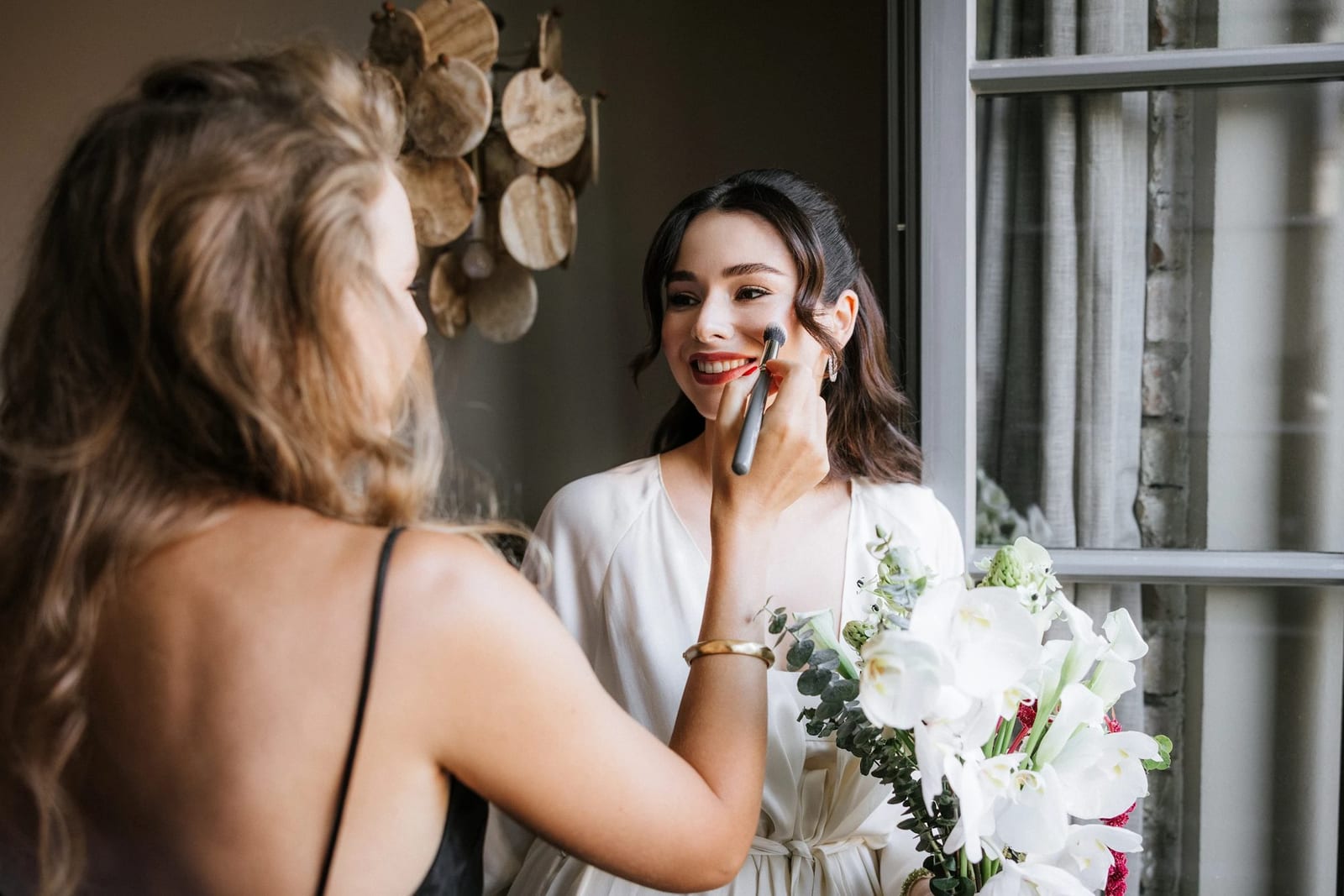
This is exactly why the era’s polish translated so well into bridal makeup, where every look has to survive hours of wear, hundreds of photographs and the unforgiving honesty of a high-resolution lens. The 2010s taught us how to build something flawless that also photographs flawlessly — and a wedding is where that combination matters most.
Conclusion
The 2010s were, above all, the decade makeup went global and went visual. A camera in every pocket and a platform on every screen turned a slow, gatekept craft into a fast, democratic, endlessly shared one. That gave us the bold, sculpted, brow-forward “Instagram face” — sometimes heavy-handed, often divisive, but undeniably skilled and brilliantly teachable. For better and worse, it set the technical bar for an entire generation of artists, myself included.
What I value most, though, is what the decade left behind once the extremes cooled. It professionalised contouring and brow work, it forced a long-overdue reckoning on shade inclusivity, and it ended by rediscovering the beauty of real skin. The “skinimalism” reset wasn’t a rejection of everything that came before — it was the craft maturing, keeping the technique and dropping the heaviness.
So when a client today asks for something “natural but polished, and lovely in photos”, they’re really asking for the 2010s, distilled. We sculpt, but softly. We define the brow, but let it breathe. We let skin glow rather than baking it flat. The Instagram era handed us a powerful toolkit, and the years since have taught us exactly how — and how gently — to use it.